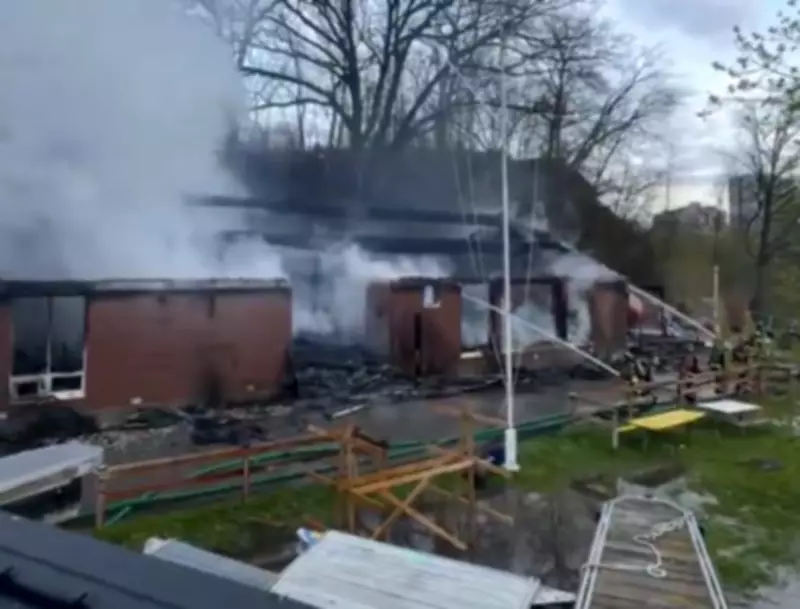
Toronto Police have announced that they are investigating the fire that destroyed the clubhouse of the Toronto Humber Yacht Club as a suspected arson. The three-alarm fire broke out early Wednesday morning, causing significant damage to the structure located on the Humber River, south of Bloor Street West, near Old Mill station.
Shannon Eames, a media relations officer with the Toronto Police Service, confirmed on Thursday that the investigation is treating the blaze as intentional. However, she stated that no further details could be disclosed at this time. Toronto Fire Services has redirected all inquiries regarding the investigation to the police.
Firefighters reported no injuries from the incident, and the boats stored on the property are believed to be undamaged. The club's vice-commodore, Wilson DaSilva, issued a statement on Wednesday evening expressing hope that if the fire was deliberately set, those responsible would be brought to justice.

The fire comes amid a contentious dispute between the yacht club and the city. DaSilva noted that there were disagreements surrounding the club, and the day before the fire, the club had served city hall with notice of a legal action seeking an emergency stay to remain on the property while the court considered the matter. City council had recently voted to terminate the club's lease, citing lease violations and environmental concerns.
Nearly 100 firefighters and 27 fire trucks responded to the blaze, which was largely extinguished by 6:30 a.m. on Wednesday. The club had been ordered to vacate the property by Thursday, marking the end of its 70-year history at the location.
Local resident Jason Sills, who led a community effort to end the club's lease, described the fire as unfortunate, noting that the building could have been repurposed as an outdoor education centre. The decision to end the lease had been contentious, with some councillors questioning the specifics of the decision-making process.
Councillor Amber Morley, who advocated for the lease termination, denied that the process was unfair and suggested that the club had failed to address compliance issues. She indicated that if the club had shown good faith in addressing these issues, further conversations could have been possible despite environmental challenges and flood risks.