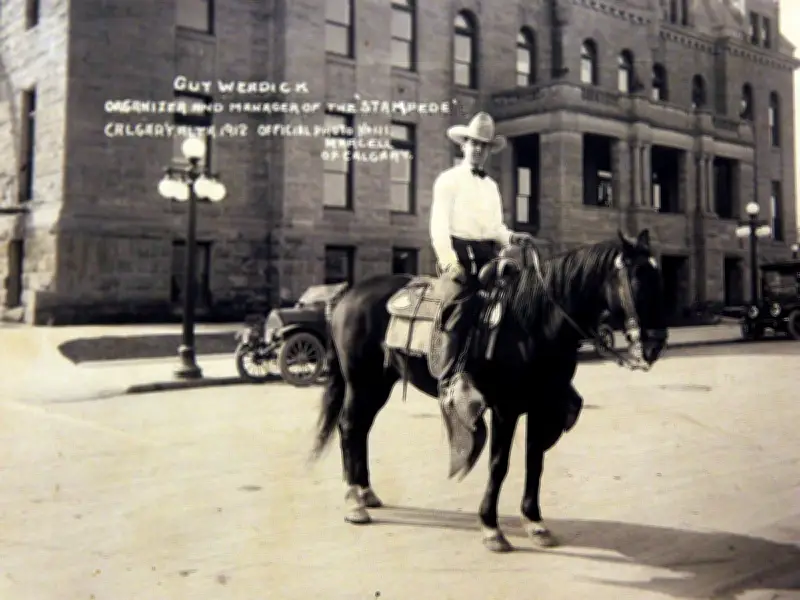
By 1932, the Calgary Exhibition and Stampede had become a combined institution built from two distinct cultures: E.L. Richardson's Exhibition and Guy Weadick's Stampede. The American-born cowboy and showman saw the Stampede as the key attraction that made the entire enterprise successful. However, financial pressures from the Great Depression led the board to impose significant cutbacks on the Stampede that year, sparking a conflict that would culminate in a 1935 lawsuit.
The 1932 Dispute
In March 1932, Weadick wrote to Richardson expressing his outrage over the reductions, stating: "I think that it is generally recognized and conceded, by not only the average citizen of Calgary and Alberta, but by visitors and others, that the Stampede is the attraction that draws the people." Richardson viewed Weadick's letter as arrogant and disloyal. At a directors' meeting on May 30, 1932, Weadick's expectations for the upcoming Stampede turned negative, a sharp shift from his optimistic January outlook. He was particularly offended by cuts to prize money, which he believed attracted top talent from across North America.
Richardson feared that Weadick's attitude would damage the reputation of the combined Exhibition and Stampede. The 1932 Stampede saw its lowest attendance since 1925, which Weadick felt justified his warnings. Yet he remained resentful, repeatedly declaring it would be his last. The company later alleged that Weadick was absent for much of the week and that on the final Saturday, he appeared intoxicated on the grandstand platform, addressed a crowd of more than 10,000 people, displaced Brigadier General Allison during prize presentations, and introduced several winners by the wrong names.

The 1935 Lawsuit
The conflict escalated into a one-day trial on March 26, 1935, when Weadick sued the Calgary Exhibition and Stampede Company. The Calgary Albertan captured the public sentiment with the headline: "Let's get on with it." Calgary had watched the showman behind the Stampede sue the organization he helped build, and by then, everyone needed to move on.
Historical Context
The Exhibition dated back to 1886, focusing on agricultural displays, livestock competitions, sporting events, and civic boosterism. Weadick, an American-born trick roper and vaudeville performer, first saw Calgary's potential during the Dominion Exhibition of 1908. In 1912, he helped launch the inaugural Stampede, featuring rodeo, frontier theatre, and cowboy culture. He returned for the Victory Stampede in 1919.
The two events merged in 1923 when Richardson, Exhibition manager since 1907, brought Weadick back to organize the Stampede as a feature of the annual exhibition. This move saved the Exhibition, which had been running an average annual operating deficit of $5,000 since World War I. With the Stampede's inclusion, attendance rose by 45,950, and the Exhibition generated a $20,000 operating surplus.
Weadick managed the Stampede component, pioneered chuckwagon races, encouraged Indigenous participation, and helped transform the event into a city-wide celebration. He understood the business side as well, arguing that prize money attracted talent across North America. By 1932, the combined institution consisted of two cultures: Richardson's Exhibition and Weadick's Stampede, with Weadick viewing the Stampede as the indispensable draw.