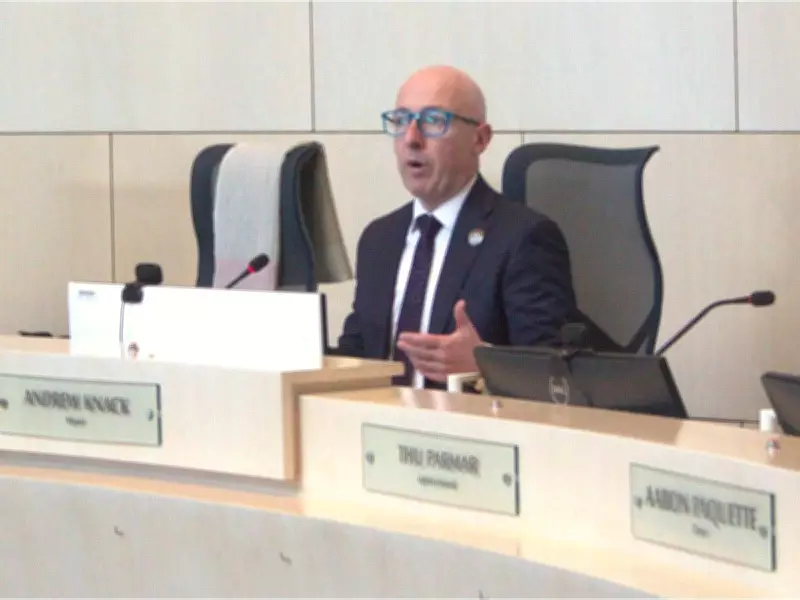
Mayor Knack Joins Calls for Province to Collect Its Own Education Tax
Edmonton Mayor Andrew Knack has intensified his advocacy for the provincial government to take direct responsibility for collecting its education property tax, rather than relying on municipalities as intermediaries. This call comes as city council embarks on a detailed examination of Edmonton's operations, with Knack emphasizing that provincial funding decisions have a significantly larger impact on the city's financial health than any internal budget efficiencies.
Provincial Cuts Outweigh Municipal Adjustments
During special council meetings that began in March and will continue throughout the month, Mayor Knack made a stark observation following initial department reports. He noted that while council is conducting a line-by-line review of city operations, the potential savings from municipal budget pruning are minor compared to the substantial effects of provincial funding reductions.
"The biggest impact would be the restoration of the infrastructure funding that's been cut for the last 15 years," Knack stated. "The infrastructure needs we have in this city are so vast. That was cut by 66 per cent since 2011 — if we could see that returned overnight, that would dramatically change the viability and ability of every municipality to provide and deliver infrastructure that the residents we serve expect."

Chronic Underfunding of Essential Programs
Knack acknowledged that the province has restored Grants in Lieu of Property Taxes to 2019 levels, but he highlighted several other critical programs that remain chronically underfunded. These include the Local Government Fiscal Framework and Family and Community Social Services, which municipalities depend on for essential services.
Edmonton was already grappling with a mounting infrastructure deficit when these programs were slashed by the Alberta government. The situation has worsened as the city's population has grown by over 200,000 people, largely due to the province's "Alberta is calling" immigration campaign. This rapid growth has caused the infrastructure gap to expand exponentially, placing additional strain on municipal resources.
Education Tax Collection System Called "Regressive"
Premier Danielle Smith has cited the influx of immigrants in 2024 as a factor in her government's budget challenges, using this to justify a nearly 13 per cent increase in the education property tax levy. The city is legally obligated to collect this tax on the province's behalf, but Knack described the current system as "regressive."
Knack pointed out that calling it an education tax is somewhat misleading, as the collected funds go into the province's general revenue fund rather than being earmarked specifically for education. "I understand the province needs more funding for education," he said. "Where I struggle is why we continue to serve as the middleman for collecting their taxes for their services. The provincial government needs to collect a certain amount of taxes to ensure they are funding education. Whatever they need to provide the services under their jurisdiction, they should collect through their income tax system."
Structural Budget Variances and Future Challenges
During budget deliberations in November, councillors were presented with several structural budget variances in the city's expense sheet that need to be addressed before they become serious problems. Knack emphasized that while municipal due diligence is necessary, the restoration of provincial funding is crucial for long-term viability.
"With that said, that does not remove us from the need of going through this re-prioritization," Knack added. "People do expect we've done our due diligence as well." The ongoing operational review aims to identify efficiencies, but Knack's comments underscore the broader financial pressures stemming from provincial policies.