The Great American State Fair, organized by President Donald Trump's Freedom 250 organization, debuted this week on the National Mall in Washington, D.C., featuring a dinosaur rib cage, a 7,000-pound sandcastle, and a 110-foot Ferris wheel. The event, which runs through July 10, aims to celebrate America's 250th anniversary but has drawn criticism for its political undertones and uneven participation.
Sparse Crowds and Political Overtones
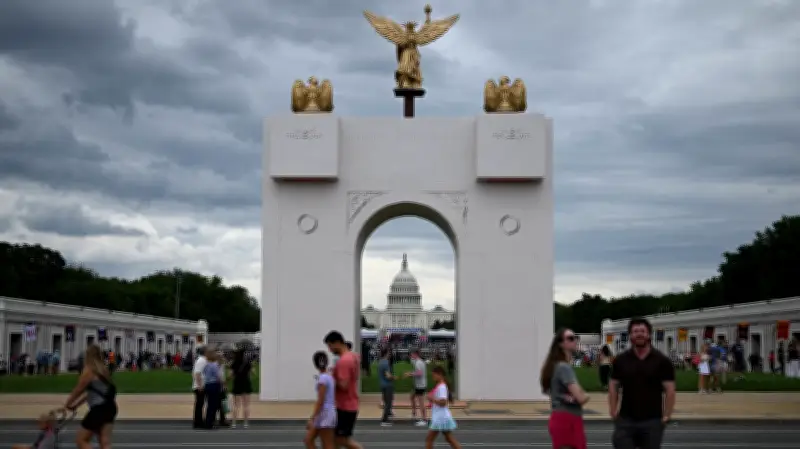
Early Friday, crowds were thin, with visitors spending little time at security. The fair's entrance led directly to a towering Ferris wheel, the only ride, and a smaller arch similar to those used at other Trump events. The arch drew particular attention from attendees like Sharyn Bovat, a Florida resident recovering from a heart attack in the Washington area. “It makes me think of Germany,” she said, referring to the arch's design.
Bovat expressed a desire for nonpartisan celebration: “Half the country is divided with the other half. I wish they would create a USA 250 for all the people. I’m tired of the politics.” Her sentiment echoed among other visitors who appreciated the fair's concept but felt it missed an opportunity for unity.

State Exhibits Showcase Americana
Montana's booth featured a giant apatosaurus rib cage, while Virginia highlighted its historical role. South Carolina offered a putting green, and Texas displayed a space capsule, a replica of the Alamo, and a Big Tex statue. Arizona's interactive exhibit attracted the only line, allowing visitors to immerse themselves in the state's terrain.
New Jersey's booth showcased an ornate sandcastle made from 7,000 pounds of Jersey Shore sand, built over four days by an artist. Andy Walters, visiting from Wapakoneta, Ohio, with his wife Kirsten and three children, said, “I think it’s nice. I wish all the states were participating. It’s a little underwhelming but it’s a great idea.” Kirsten Walters added, “We’re excited to be here and participate,” though she wished such events were held more often without political overtones.
Non-Participating States and Unstaffed Booths
Most states participated, treating the fair as a tourism opportunity, but Maine, Massachusetts, and Pennsylvania opted out, citing costs, scheduling, or politicization concerns. Pennsylvania's senators, Democrat John Fetterman and Republican Dave McCormick, announced Saturday they had collaborated with business trade organizations to ensure the state would have a showcase worthy of its history.
Some booths, including Hawaii's and Alaska's, were unstaffed. Hawaii's booth featured rocking chairs, which tired visitors like Alonzo Lewis Jr. and Kelly Domizio from Rome, New York, used to rest. Domizio recalled the bicentennial in 1976: “There was a sense of pride and togetherness. We are enjoying the day but it feels forced.” Her husband added, “Was it necessary? I don’t think so. It feels forced. There’s so much separation.”
Livestock and Performances Attract Families
The fair included livestock from the Washington High School Future Farmers of America in Jefferson County, West Virginia, with goats, sheep, and a calf whose mooing carried across the Mall. Baby chicks drew crowds, and a cowboy performance with bucking broncos was promised to highlight the American cowboy heritage.
Despite the fair's intent to showcase state pride and diversity, the political divisions surrounding its organization and execution left some visitors longing for a more inclusive celebration. As the event continues through July, its success may hinge on whether it can bridge those divides.