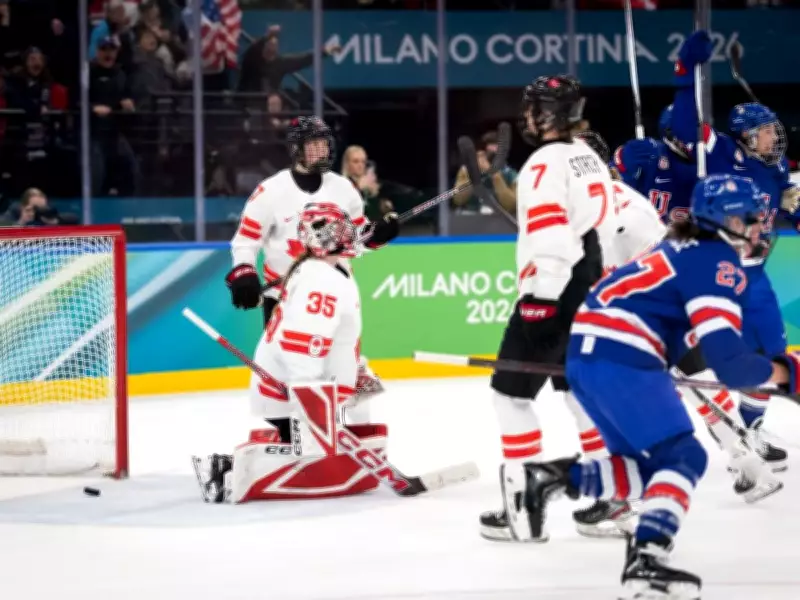
Canada's Women's Hockey Torch Passes to the United States
The landscape of international women's hockey has undergone a seismic shift. Following a dramatic overtime loss in the Olympic gold medal game, it is now official: the United States has supplanted Canada as the preeminent force in the sport. This transition marks the end of an era for Canadian hockey supremacy.
A Golden Goal Seals the Shift
The pivotal moment came at the Santagiulia Ice Hockey Arena in Milan. Despite holding a narrow 1-0 lead late in the third period, Team Canada could not withstand the American onslaught. With their goaltender pulled for an extra attacker, U.S. veteran Hilary Knight scored a crucial tip-in goal with merely 2:03 remaining in regulation, forcing overtime. The final blow was delivered by Megan Keller, whose golden goal concluded an intense goaltending duel between Canada's Anne-Renée Desbiens and the U.S.'s Aerin Frankel.
This victory extended the United States' winning streak against Canada to eight consecutive games, during which they have outscored their northern rivals by a staggering 28 goals. While the Canadian team displayed commendable fight and determination, the result underscored a deeper, systemic issue within their program.

The Age Gap and Talent Pipeline Crisis
A critical examination of the rosters reveals a stark demographic contrast. The Canadian team is notably older, featuring nine players over the age of thirty and only five born in the 21st century. This reliance on veteran experience, while valuable, masked a significant vulnerability.
Conversely, the United States has aggressively rejuvenated its lineup since its defeat at the 2022 Beijing Olympics. Their current squad boasts only five players over thirty, with twelve players born since the year 2000. Notably, seven members of the U.S. Olympic team are still actively competing in collegiate hockey, highlighting a vibrant and continuous talent pipeline.
The decline of Canada's women's program appears poised to continue, running parallel to the rapid improvement of European talent and the sustained development of a deep and prolific U.S. player pool.
College Hockey: The Engine of American Dominance
The foundation of American success is undeniably rooted in the NCAA system. U.S. college hockey supplies the overwhelming majority of players for the Professional Women's Hockey League (PWHL). Although Canadians constitute one-third of the talent at the NCAA Division I level, with 372 players, a new trend is emerging.
The influx of European players into American colleges is rising at a steady clip. According to analyst Nicole Haase, there are a record 89 non-North American players at the Division I level this season, a significant increase from just 60 players two years prior. This diversification enriches the U.S. developmental system further.
Perhaps more telling is the prospect ranking. A recent Hockey News list of PWHL draft-eligible players featured only one Canadian, Issy Wunder of Princeton, at number 14, with no others in the top twenty.
Semifinal Scare and Broader Olympic Context
Canada's path to the final was far from assured. The team narrowly escaped the semifinals with a 2-1 victory over Switzerland, relying on two goals from captain Marie-Philip Poulin. Swiss goaltender Andrea Brandli was spectacular, making 44 saves to keep her team in contention. Brandli later backstopped Switzerland to a bronze medal with a 2-1 overtime win over Sweden.
The Olympic tournament also delivered surprises on the men's side, reinforcing that elite hockey extends beyond the NHL. Traditional powerhouses like Canada, the U.S., and Finland all required overtime to advance to the final four. Canada's "dream team," heavily favored with NHL stars, was pushed to the limit by Czechia, needing a late tying goal from Montreal Canadiens' Nick Suzuki and an overtime winner from Mitch Marner to survive.
Implications for the Future of International Hockey
The success of nations like Slovakia, Switzerland, and Germany at the Olympics, often with rosters not exclusively filled with NHL players, presents a dilemma for international hockey organizers. As the sport looks ahead to the next best-on-best competition, the 2028 World Cup of Hockey, the traditional invitation model may need revision.

The previous format in 6 invited only the nations with NHL-heavy rosters, filling other slots with composite teams. With Russia currently sidelined, there are openings. The Olympic performances suggest it may be time to formally recognize that competitive, medal-winning teams can be built from talent pools outside the NHL, signaling a more global and inclusive future for the sport's premier events.