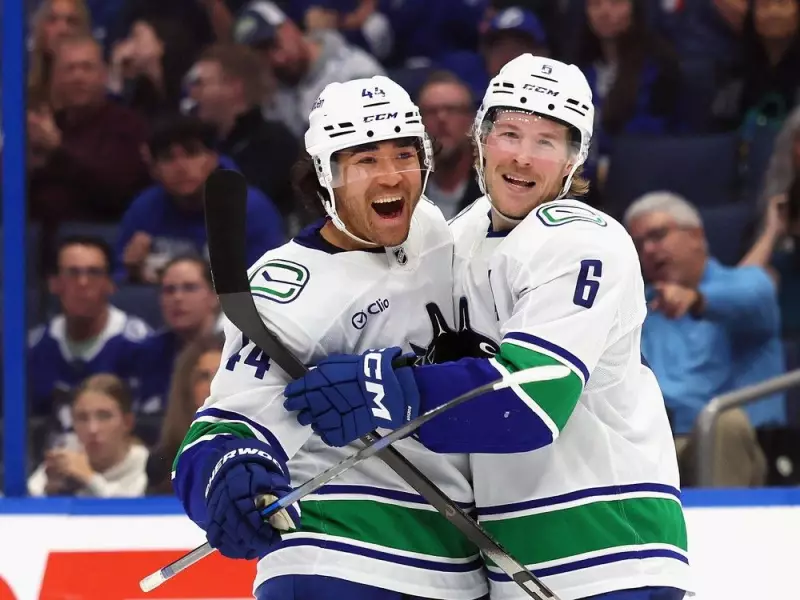
From Agitator to All-Around Asset: Kiefer Sherwood's Remarkable Transformation
The journey of Vancouver Canucks winger Kiefer Sherwood represents one of the most compelling development stories in recent NHL memory. What began as a role defined by agitation and physicality evolved into a complete hockey package that commanded significant trade value.
Drawing Inspiration from Canucks Legends
Former Vancouver Canucks agitator Derek Dorsett established a legendary reputation among faithful fans for his unwavering willingness to drag his club into the fight. He played hard, played hurt, and never quit—qualities that caught Sherwood's attention early in his professional career.
"Dorsett had to scrap and claw for everything he got out of the game," Sherwood once explained. "I always respected him from afar, and as I got my pro career going, I try to model my game after that feistiness and pit-bull mentality."

Sherwood developed a sophisticated understanding of his role, noting: "I try to find the triggers and what makes people a little self-conscious. Get them off their games and get them talking about me and less about our other guys and free them up. And on the PK, I use my speed and stick to disrupt and I use it as an energy shift."
The Complete Player Emerges
Dorsett recognized the evolution in Sherwood's game, observing: "Kiefer has done a tremendous job of finding that niche role. He has figured out what it takes to stick and be an effective player. You can make a good living being physical and finishing checks. He has a long runway ahead of him."
Sherwood's transformation became particularly evident during his time with the Canucks. He arrived with specific boxes to check after making an impression as a pain to play against with the Nashville Predators during the 2024 playoffs. What followed exceeded expectations.
No longer merely a one-dimensional forechecker designed to get under opponents' skin, Sherwood developed into something more substantial than previous franchise agitators like Dorsett, Antoine Roussel, or Jarkko Ruutu. He became better—a complete player who was leading the Canucks in goals (17), hits (210), and energy before suffering an injury.
Trade to San Jose and Future Prospects
The culmination of Sherwood's development in Vancouver resulted in significant trade interest, with the San Jose Sharks ultimately acquiring the pending unrestricted free agent. The Canucks received second-round NHL Draft picks in 2026 and 2027, plus 25-year-old right-shot defenceman Cole Clayton.
Sherwood now faces a pivotal career moment with the opportunity to either secure a long-term contract from the Sharks or test free agency waters. The Canucks had explored contract extension talks during the summer, but term became a sticking point that prevented agreement.
"Their (Sharks) rebuild is probably happening quicker than they thought and they have special players in their system," Sherwood acknowledged about his new team. "Pretty exciting, but I'm just trying to stay in the present and process everything."
Foundation of Success and Cultural Impact
Sherwood's breakthrough followed a string of four one-year deals at league minimum elsewhere, providing the impetus for a career-high 19 goals last season and an NHL record 464 hits. This foundation supported his current campaign, during which he emerged stronger, faster, and more accurate with his shot while reducing penalty box visits.
Canucks head coach Adam Foote highlighted Sherwood's broader impact: "He builds culture. He had to play with high energy and emotion to make it and did a great job this year learning to control it. Guys like that, you don't want them to control it completely, because that's what makes them special."
Foote added an important perspective on emotional play: "Live with a bad penalty here and there if it comes from emotion, because that's okay."
Gratitude and Legacy in Vancouver
Reflecting on his Vancouver tenure, Sherwood expressed profound appreciation: "I'm thankful for everything this city and organization has given me. I know they say you earn it, but you've got to have the opportunity. As a guy who's a late bloomer, it was everything I could have hoped for and more. I'm leaving with my head held high."

He described his approach simply: "I just put my work boots on. I hope it opens the pathway for other late bloomers one day. A lot of good players in the AHL and they just need some time to figure it out. That's why I was so grateful coming here. Be myself. To have fans chant my name is crazy and sometimes I still process and look back on."
Sherwood concluded with heartfelt sentiment about his Vancouver experience: "A special place to play and that's the hard part of the business. You get attached. They do things the right way here and really live and breathe hockey."
The Next Generation
With Sherwood's departure, attention naturally turns to whether the Canucks possess a budding Sherwood 2.0 within their roster or system. Twenty-one-year-old winger Liam Ohgren presents intriguing possibilities with his combination of size, speed, hard hitting, net presence, and good release.
Coach Foote sees significant potential: "You can see he's a horse. He's so young and has got the speed, and the power is going to come. It's going to be interesting to see where he's at in a few years with speed and strength already."
Sherwood's journey from undrafted agitator to complete player serves as both inspiration and blueprint for player development—demonstrating how preparation meeting opportunity can transform careers and create lasting impact within hockey organizations.