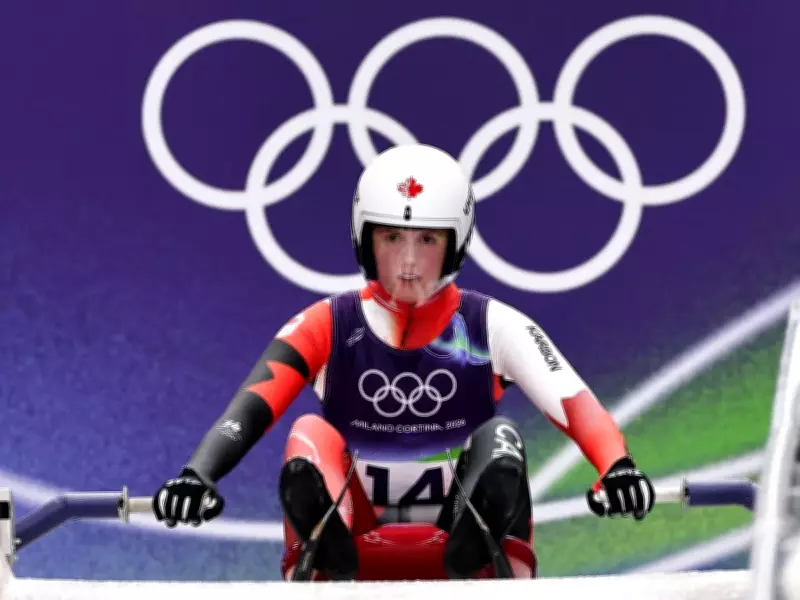
Canada's Olympic Youth Movement Shines Through Gen-Z Lugers at Milan-Cortina Games
Canadian Olympic officials acknowledge they have brought an older contingent to Italy this month for the Milan-Cortina Games, but this generalization doesn't apply to the nation's luge team, which represents a distinct youth movement within the delegation.
A Veteran-Heavy Canadian Contrasted by Luge's Fresh Faces
Canada's Olympic team in Cortina d'Ampezzo features numerous decorated athletes approaching the twilight of their storied careers, including hockey legend Sidney Crosby and speedskater Ted-Jan Bloemen, alongside a golden generation of curlers aiming for final Olympic triumphs. However, on the luge track, a different narrative unfolds—one dominated by youthful energy and first-time Olympians.
Canada's Cortina luge team is decidedly Generation Z, with five of six members making their Olympic debuts. The squad is led by Pemberton, British Columbia's Trinity Ellis, who at 23 stands as the team's only veteran of previous Games. Among the young talents is Embyr Susko, part of Canada's contingent of 20-year-olds at these Olympics. Only snowboarders Eli Bouchard and Felicity Geremia (both 18) and hockey star Macklin Celebrini (19) are younger than Susko within the Canadian delegation.

Susko's journey into luge began when she was just four years old, watching the 2010 Olympics in her hometown of Whistler. For 23-year-old Calgarian Devin Wardrope, his first memorable news event was the 2008 financial crisis, highlighting the generational perspective this team brings to the Games.
Gaining Experience in a Sport Demanding Precision
This young luge group approaches the Olympics with determination while recognizing that this year's competition serves primarily as a learning experience in a sport where nothing substitutes for actual Olympic performance. "Devin and I are definitely among the oldest on our team, which feels pretty unusual," noted 24-year-old Cole Zajanski, Wardrope's teammate in men's doubles. "When we compete against athletes around us who are in their late 20s or early 30s, it really puts things in perspective: luge isn't necessarily a young person's sport—it's about accumulated experience."
Traditionally dominated by German, Italian, and Austrian athletes, Canadian luge reached its peak in 2018 with the program's only two Olympic medals: a bronze for Alex Gough in women's singles and a silver in a relay team comprising Gough, Sam Edney, Tristan Walker, and Justin Snith.
Wardrope emphasizes that luge demands serious athleticism: "We're not just lying there on the sled." Another crucial aspect involves meticulous data-gathering. Since no two tracks are identical, success depends on carefully analyzing ice conditions during practice runs, then determining the optimal racing line and sled configuration for competition day.
The Experience Gap and Cultural Dynamics
This is where younger luge athletes often face disadvantages. Wardrope and Zajanski, for instance, have approximately 150 career runs on Oberhof, a German track considered something close to luge's Valhalla. Their German competitors, by contrast, have tested that same track thousands of times. Even veteran international teams approach the Canadian duo's run totals at Whistler (around 2,000-2,500 runs), their home track.
"You simply need substantial run volume on each track to become accustomed to all the variables it can present," Zajanski explained regarding the experience gap.
While staying at the athletes' village in Cortina, neither Zajanski nor Wardrope has felt a significant generation gap with older teammates, though Wardrope has become the resident IT expert. Occasionally, older team support staff require explanations of Gen-Z slang terms.
"They sometimes just scoff at us and tell us to speak normally," Susko remarked about these linguistic exchanges, highlighting the lighthearted cultural dynamics within the team.
This determined group of young Canadian lugers represents not just the future of their sport nationally, but also a vibrant youth movement within an otherwise veteran-heavy Olympic delegation, gaining invaluable experience on the world's biggest winter sports stage.