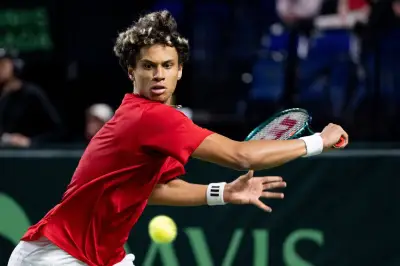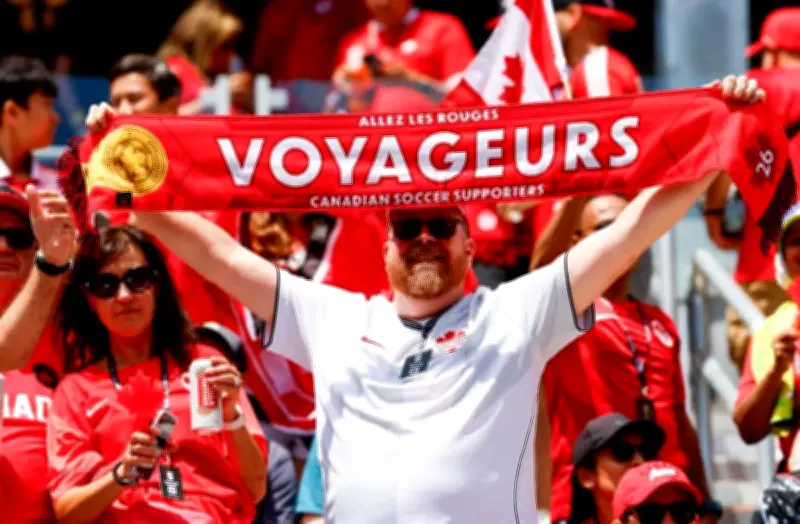
There were stars and celebrities, fans decked out in red and flags, and doting family members holding signs of adoration. If ever proof of home field advantage was needed, the thundering red wave that engulfed BMO Field in Toronto on Friday will serve as evidence.
When Canada was announced as one of the joint hosts of the 2026 World Cup, the pressure turned off and the hype ramped up. Automatic qualification meant the team could focus on honing its roster and tactics instead of worrying about slogging through CONCACAF opponents. Playing on home soil, the players often said, would give them an undeniable advantage.
A Slow Start
But 20 minutes into the first half on Friday, a tentative and loose performance marking Canada's third entry into World Cup play saw them trailing Bosnia-Herzegovina 1-0, their advantage splintered by a Jovo Lukić header. The hundreds of visiting fans danced and chanted, creating a ruckus from the comparatively small portion of the 43,002 fans reverberating around the stadium's expanded seats. The joyful spotlight Canada had enjoyed as the excited darlings of the nation now glowed with the murderous intensity of a heat lamp.

Second Half Surge
But it was a different Les Rouges who took the field in the second half. Aggressive and unrelenting, the crowd began to feed off the rising energy and reflected it back to the team exponentially more intense. Coach Jesse Marsch noted, “As they started to feel that the team was growing into the game … you could feel them cheering louder and being more anticipatory and pushing the group. The crowd, I think, willed us into the game.”
The eruption that poured out of the crowd when Cyle Larin equalized in the 79th minute, ultimately giving Canada its first World Cup point, was a cathartic release of pent-up angst that became joy. Larin plugged his ears, signalling he never listens to his detractors, before pulling his arms wide and letting the roar wash over him. “I score when Canada needs me to, and I’ve always done it,” he said.
He needed it, ending a 14-game goalless drought with the country. And the country needed it too. Midfielder Ismaël Koné, the player of the game — the first Canadian to earn that honour at the World Cup — said, “When we scored … you can see we’re creating a movement, we’re creating a culture, and I hope it keeps beating because we’re going to need it. We want our country to be behind us. We want them to be proud. This is why we run so much. This is why we push every day.”
The Role of the Fans
Marsch marvelled at how Toronto had been alive all week. When asked about the numerous celebrities in attendance — including Ryan Reynolds and Conor McDavid — he revealed his fandom. “Wait, Mike Myers was here? Oh, sweet!” he said. But it was about the rest of us that he had the most to say. “All the red jerseys were outstanding. How awesome was that to look around and see all those red jerseys, the sea of red in the stadium, and push the team … That was a big factor in why we were able to get the point today.”
Looking Ahead to Vancouver
The team hopped on a plane Saturday to leave the region that more than half of the 26 players cite as their home, getting ready for two games at B.C. Place: June 18 against Qatar and June 24 versus Switzerland. If there ever was a chance for Vancouver to lean heavily into its one-sided rivalry with Toronto, it’s now. Thursday’s game against Qatar is well short of a sellout, and tickets are still available for the group stage finale against the Swiss.
Marsch called on Vancouver to show up and show out. “We need the same in Vancouver. Keep pushing this team, keep rooting on the goals. We’ve got to give these guys confidence and make them believe that they can be winners. That’s what we need. We need the home crowd to push the team to put pressure on referees, to create a hostile environment for the opposing teams. I know that it’s a football city, I know they love their Whitecaps, I know they love their national team. So I expect a full stadium again, red jerseys.”

Psychological and Tactical Adjustments
It would be unfair to say Canada has a fragile mentality that relies on external motivation, but the players are as human as the rest of us. Marsch has spent a long time building up internal belief. As a coach, you’re part tactician, part psychologist. Larin was seen as Jonathan David’s natural strike partner coming into the tournament, but a long scoring dry spell dating back to October 2024 was compounded by ineffective showings in warm-up games, and he started Friday’s game on the bench in favour of Tani Oluwaseyi.
Marsch said, “I knew Cyle wasn’t happy about not starting … but I said to him, ‘look, you’ve had a great year at Southampton … now you have to wrap your mind around that.’ On one level, you can say the subs made a big impact … but I’ve got to figure out how to get a little bit more out of some of the starters too … I told them after the match that if we play like that second half, the whole match, we win, right? We’ve got to find a way to have a bit more confidence and a bit more self-belief.”
Group Stage Implications
Both Marsch and his Bosnian counterpart, Sergej Barbarez, were satisfied with the draw, which keeps the door open for advancing out of the group. The door opened wider on Saturday when Qatar posted a miracle tie against Switzerland. Down 1-0 in injury time and being outshot 26-6, the Qataris got a miracle goal from Boualem Khoukhi in the 95th minute that cancelled out Breel Embolo’s 17th minute penalty. It was their first World Cup point.
Call it a Merry Swiss miss for Canada, who play Qatar on Thursday. A win would all but guarantee a spot in the knockout round, even if they lost to the Swiss. With two 1-1 draws in the books, goal differential could come into play to see who advances.
Larin said, “We’ll be playing home again in Vancouver, and then we’ve just got to push the limit and be killers around the goal.” Marsch added, “I do think we’ll learn from this. If you look at World Cups historically … it starts a little bit tense … then the games come more to life, and I think you see truer versions of teams. So, for us, it’ll be really important that we use this experience to be better and stronger and more prepared for exactly what we want the game to look like.”