Lenovo, as FIFA's Official Technology Partner, is revolutionizing the 2026 FIFA World Cup with groundbreaking AI-powered innovations that enhance referee decisions, provide advanced tactical data to teams, and create immersive viewing experiences for fans worldwide. The technology, showcased during the Round of 16, includes RefCam video stabilization, FIFA AI Pro analytics, and digital twins of stadiums.
RefCam Stabilization Enhances Broadcast Quality
One of the most visible innovations is RefCam technology, officially called "Referee View." A small, lightweight camera worn on the main official's head captures the referee's point of view during matches. Lenovo's proprietary algorithm stabilizes the feed, reducing jitter caused by rapid movement. According to Cathy Meister, Lenovo's executive director of North America PC & Smart Device Sales, the technology has led to a feed with up to 60% jitter reduction and up to 70% smoother trajectory, with no degradation in video sharpness. The output remains at 1080p resolution at 60 frames per second, with only three-second latency. This footage is integrated live into broadcasts and used for post-match analysis.
FIFA AI Pro Delivers Real-Time Tactical Insights
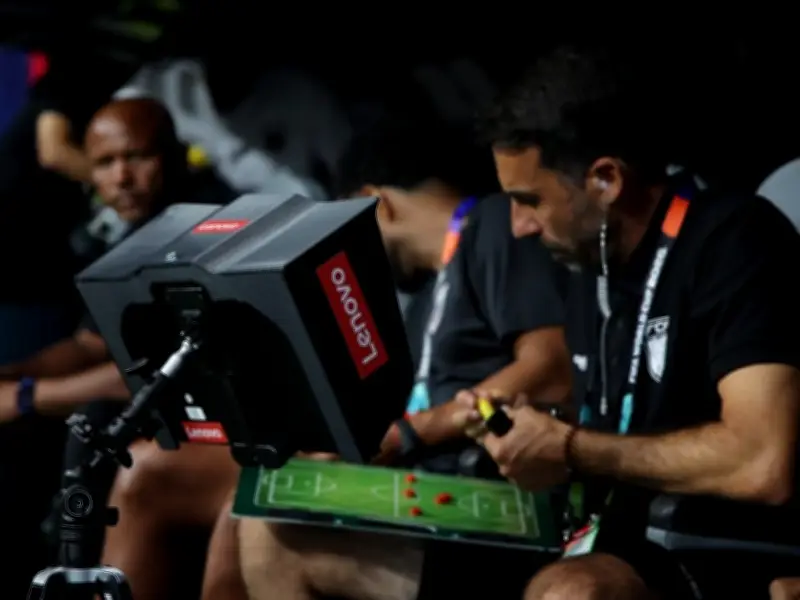
FIFA AI Pro, a hybrid and generative AI tool, collects millions of data points and shares them across all 48 participating teams. It provides real-time analytics to players, coaches, and analysts, helping level the playing field regardless of team resources. Meister explained, "It's providing them with real-time analytics – insights that can help players, coaches and analysts – essentially helping to level the playing field for all of the teams." The tool fuses match data, video footage, and 3D visualizations to deliver tactical insights and strategic recommendations in plain English. For example, a coach can prompt: "Show me all instances where our next opponent lost possession in the middle third during their last three matches," and the AI instantly generates a video montage pinpointing transition weaknesses.

3D Player Scans and Digital Twins
Lenovo created AI-powered 3D reconstructions of all 1,248 participating players across all 48 teams, supporting match officials with offside decisions and enhancing fan views of key moments. This first-of-a-kind project also underpins digital twins of the 16 venues in Canada, the United States, and Mexico. These virtual replicas enable organizers to monitor crowd flow, manage security, and optimize operations in real time. Fans can use connected smart wayfinding apps to navigate venues, locate empty restrooms, and find the shortest concession lines. The digital twins are being upgraded for the 2027 FIFA Women's World Cup in Brazil.
Separate from VAR Technology
Lenovo's RefCam technology is distinct from FIFA's VAR (Video Assistant Referee) system, which handles player tracking and offside determination using data from a sensor in the ball. VAR is powered by Hawk-Eye Innovations, a partner of FIFA since 2017, and utilizes Hisense RGB MiniLED displays in VAR rooms at the International Broadcast Centre in Dallas.
Hologram and Fan Experiences
At many World Cup stadiums, hologram technology creates unique fan experiences, including selfies with mascots and players, and personalized retail opportunities like superimposing team jerseys on fans' bodies.
Marc Saltzman, host of the Tech It Out podcast and author of Apple Watch For Dummies, reported on these innovations after visiting Lenovo's New York City offices and attending the France-Sweden match at the New York New Jersey Stadium.