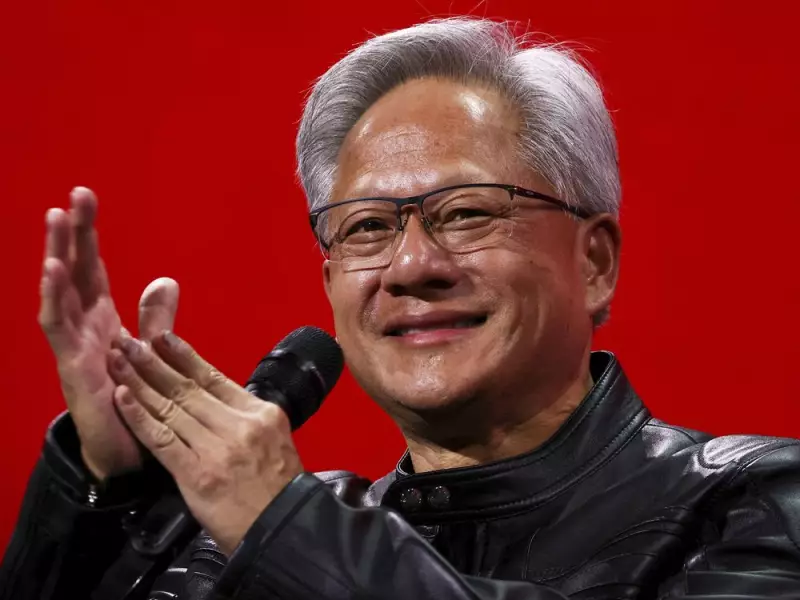
In a testament to his pivotal role in shaping the modern technological landscape, Nvidia's chief executive Jensen Huang has been named the Financial Times Person of the Year for 2025. The recognition comes as Huang's company sits at the epicentre of an artificial intelligence revolution that is fundamentally reshaping the global economy and sparking one of history's most significant private-sector investment waves.
From a Birthday Call to the Corridors of Power
The year marked a dramatic shift into the political spotlight for the typically low-profile tech executive. The transition was symbolized by an unexpected phone call Huang received on his birthday in February. While celebrating at home with his wife, he noticed several missed calls from an unknown number. As he was about to dismiss them, the phone rang again.
"Hello Jensen: this is President Trump," the voice said, as Huang's dogs began barking. Initially suspecting a prank, Huang recalls asking, "Really, is this President Trump?" The impromptu conversation lasted 45 minutes, marking the start of an unusual relationship between the former U.S. president and the self-made billionaire, who is the son of Taiwanese immigrants.

This move into high-stakes politics bore tangible fruit recently with the announcement that Nvidia will once again be permitted to sell its advanced AI chips in China, a decision that had faced opposition from parts of the national security establishment.
Building the Engine of the AI Era
Under Huang's three-decade leadership, Nvidia has evolved from a niche graphics chipmaker into the indispensable engine of the AI boom. For years, semiconductors were the overlooked foundation of the digital world, but in 2025 they emerged as the critical impetus behind the AI mania sweeping business and finance.
The FT's designation highlights Huang's central role in this transformation. He has been the visionary behind a colossal private-sector investment program that has propped up the U.S. economy and sustained a stock market boom. His company's graphics processing units (GPUs) have become the de facto standard for training and running powerful AI models like ChatGPT, which launched three years ago.
The financial results of this dominance are staggering. Nvidia briefly became the world's first company to reach a market valuation exceeding US$5 trillion this year and remains the most valuable firm globally, with a capitalization of US$4.4 trillion as of Thursday evening. Huang himself is poised to end 2025 with a net worth surpassing US$160 billion, placing him among the planet's ten wealthiest individuals.
A Consequential Leader Facing New Frontiers
Despite the astronomical success, Huang, known for his voracious work ethic and hands-on engineering focus, remains characteristically cautious. He has long warned that any technological lead is fragile. Significant challenges loom, including impressive advances by Chinese chipmaker Huawei and efforts by tech giants like Google to develop their own competing AI chips.
Yet, Nvidia's position at the forefront of AI chipmaking has proven remarkably resilient. Huang now embraces a public role as a tech prophet and visionary, matter-of-factly describing Nvidia as "one of the most consequential technology companies in history."
The scale of Nvidia's impact is such that even if its current valuation were halved, the company would still be worth three times more than it was at the end of 2021. This underscores not just a fleeting market trend, but a profound and lasting shift in the technological order, masterminded by Jensen Huang.