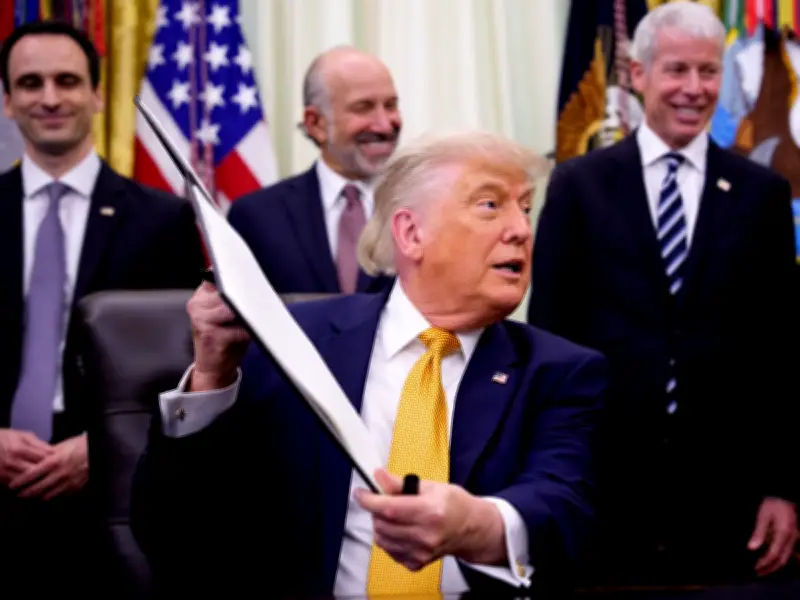
President Donald Trump signed executive orders on Monday aimed at accelerating quantum research, mandating federal adoption of the technology, and strengthening United States defenses against quantum-powered cyberattacks. The orders position the Trump administration to benefit from the quantum computing industry's success and assert U.S. leadership in a field with major national security implications.
Orders target quantum computing and post-quantum cryptography
Trump announced the orders at the White House, joined by Alphabet Inc. President Ruth Porat and International Business Machines Corp. chief executive Arvind Krishna. The first order launches an effort to create a quantum computer capable of performing important scientific calculations. White House officials, who briefed reporters on condition of anonymity, said they believed such a computer could be developed by 2028.
The order also directs agencies to develop plans to deploy quantum-enabled sensors and networks within the next five years. Additionally, it supports coordination with allies to protect quantum intellectual property and bolster supply chains.

Second order mandates migration to quantum-resistant encryption
A second executive order seeks to accelerate U.S. deployment of algorithms that can resist quantum-powered cyberattacks. Federal agencies must migrate to post-quantum cryptography standards for high-value assets by 2031 at the latest. Quantum technologies remain mostly theoretical and unproven at scale, but they could eventually break standard encryption used to secure bank payments and other sensitive information.
The Commerce Department in 2024 approved three algorithms, which can run on classical computers, as resistant to potential quantum-powered cyberattacks. The U.S. has sought protection from such strikes since at least 2016, when a Commerce office began searching for risk-mitigation techniques.
Industry collaboration and economic impact
Senior White House officials declined to identify specific companies the U.S. will work with, but the orders include a directive for the government to partner with domestic industry players, according to a fact sheet. This could provide a broad boost to the quantum industry. Valuations of quantum computing companies have soared this year, riding on investor interest in artificial intelligence and bets on the next tech breakthrough.
IBM shares rose 2.4% in postmarket trading following the announcement. Trump said the orders would boost the U.S. “as the world leader in this very important emerging field. We’re already the leader by a lot, and we’re going to be now the leader by a lot more.”
Technical specifications and national lab deployment
Officials said the Energy Department will set technical specifications for building a research-relevant quantum computer, though they cautioned it would be only a step toward more capable systems. The computer is set to be delivered to a national lab or other Energy Department facility.
The orders come amid a race between the U.S. and China to assert dominance in quantum computing, a nascent sector with profound national security implications. The White House emphasized collaboration with allies to protect intellectual property and secure supply chains.