Historic Breakthrough in Stellar Observation
In a groundbreaking development that expands our understanding of cosmic weather patterns, astronomers have successfully identified and documented a storm occurring on a star beyond our solar system for the very first time. This remarkable discovery, announced on November 12, 2025, represents a significant milestone in astronomical research and opens new frontiers in studying stellar atmospheres.
The Discovery Details and Methodology
The unprecedented observation was made possible through advanced monitoring techniques and sophisticated instrumentation that allowed scientists to detect atmospheric disturbances on a distant star. While the specific star involved in this discovery wasn't named in the initial report, the detection method likely involved analyzing light variations and spectral changes that indicated turbulent atmospheric activity.
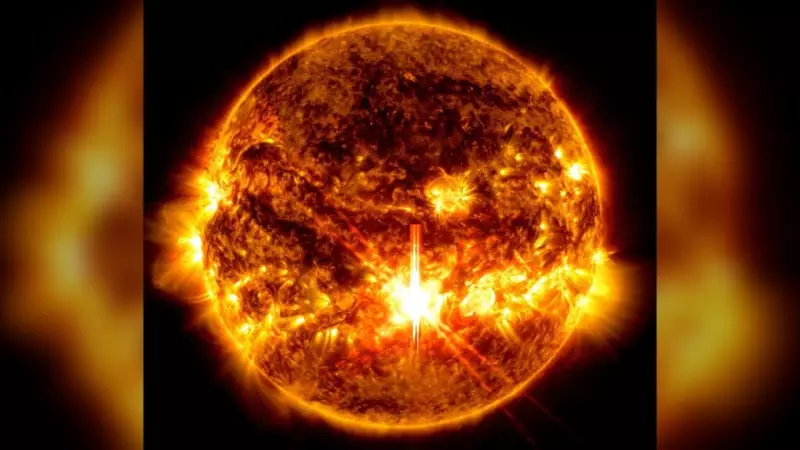
This discovery comes shortly after NASA's Solar Dynamics Observatory captured a significant solar flare on October 3, 2024, demonstrating the ongoing advancement in our ability to monitor and understand stellar phenomena. The observed stellar storm appears to share some characteristics with solar weather events but on a potentially much larger scale.

Implications for Future Space Research
The detection of extraterrestrial stellar storms has profound implications for multiple fields of study. This breakthrough provides astronomers with new tools to understand the life cycles of stars and how stellar weather might affect planetary systems orbiting these distant suns.
Researchers believe that studying these stellar storms could help us better predict space weather events that impact Earth's technological infrastructure, including satellite communications and power grids. The discovery also raises intriguing questions about how common such phenomena might be throughout our galaxy and what conditions are necessary for these massive stellar weather events to occur.
As astronomical observation technology continues to improve, scientists anticipate that this first detection will lead to many more discoveries of stellar weather patterns, potentially revolutionizing our understanding of how stars behave throughout their lifetimes and how their activity might influence the development of life in their planetary systems.