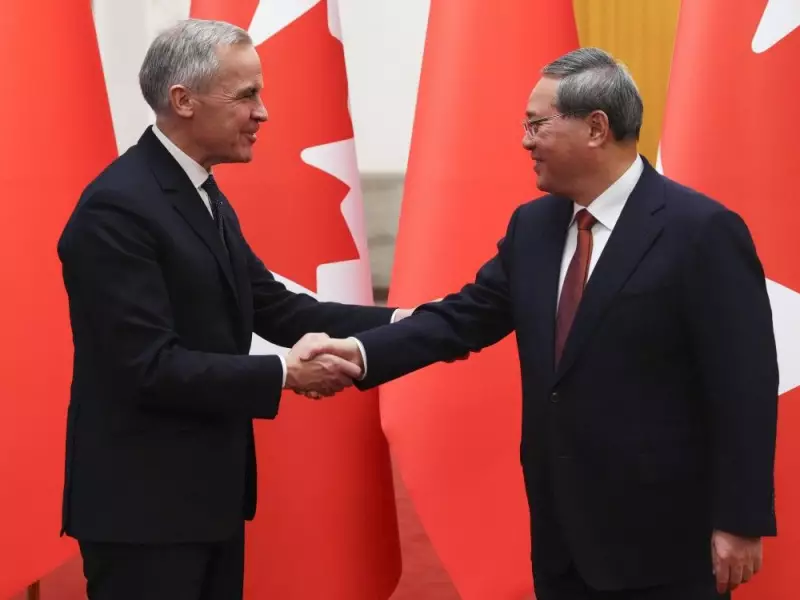
Prime Minister Mark Carney has embarked on a mission to renew Canada's relationship with China, marking a significant diplomatic push to diversify the nation's trade partnerships and bolster economic security. The visit to Beijing, which began on Thursday, January 15, 2026, is Carney's first to the country as prime minister and the first by a Canadian leader in over eight years, since Justin Trudeau's trip in December 2017.
A Strategic Thaw in Frosty Relations
Carney's high-level meetings included sit-downs with Premier Li Qiang and Chairman Zhao Leji, China's second and third highest-ranking officials. The discussions, held at the Great Hall of the People, focused on revitalizing a bilateral relationship that has been strained for years. Tensions escalated notably after the December 2018 arrests of Canadians Michael Spavor and Michael Kovrig in China, widely seen as retaliation for the arrest of Huawei CFO Meng Wanzhou in Vancouver. Further complications arose from allegations of Chinese interference in Canada's 2019 and 2021 federal elections.
"From energy to agriculture to people-to-people ties to multilateralism to issues on security, we believe that the spirit and the substance of these discussions, and these agreements, will provide great benefit to each of our peoples," Carney stated during the meetings, according to a Canadian Press report.

Driving Force: Diversifying Trade Beyond the U.S.
The diplomatic reset comes at a critical juncture for Canadian trade policy. The visit is a direct response to growing economic pressures from the south, where U.S. President Donald Trump's administration has waged a trade war over the past year, slapping tariffs on Canadian goods. With the United States as Canada's largest trading partner, this friction has underscored the urgent need to grow and diversify trade with other nations without jeopardizing the vital North American trade relationship.
China, as the world's second-largest economy and Canada's second-largest trading partner, is a logical focal point for this strategy. Following his talk with Premier Li, Carney took to social media to emphasize common ground. "Our countries align in many areas, such as clean energy, agriculture, and finance," he posted on X (formerly Twitter). "We focused on how Canada and China can work together to build stronger, more sustainable economies for both our nations."
Addressing Trade Irritants and Building Bridges
The Prime Minister's agenda also included meetings with top executives from major Chinese corporations, including Alibaba, China National Petroleum, EV battery giant Contemporary Amperex Technology (CATL), Primavera Capital Group, and the state-owned ICBC bank. These talks aimed to address specific trade barriers and explore new commercial opportunities.
Significant trade irritants remain on the table. Notably, China maintains a 100% tariff on canola exports from Saskatchewan—a retaliatory measure against Canada's 100% tariff on Chinese electric vehicles, implemented to protect Ontario's auto industry. An official readout from the meeting with Li Qiang noted that "significant progress was made in recent months" and that leaders discussed global economic challenges and supply chain issues.
Carney's government has publicly stated its goal to double Canada's exports to non-U.S. markets within the next decade. This Beijing visit represents a cornerstone effort in that ambitious plan. The Prime Minister is scheduled to meet with Chinese President Xi Jinping on Friday, January 16, 2026, a conversation that will likely set the definitive tone for this new chapter in Canada-China relations.