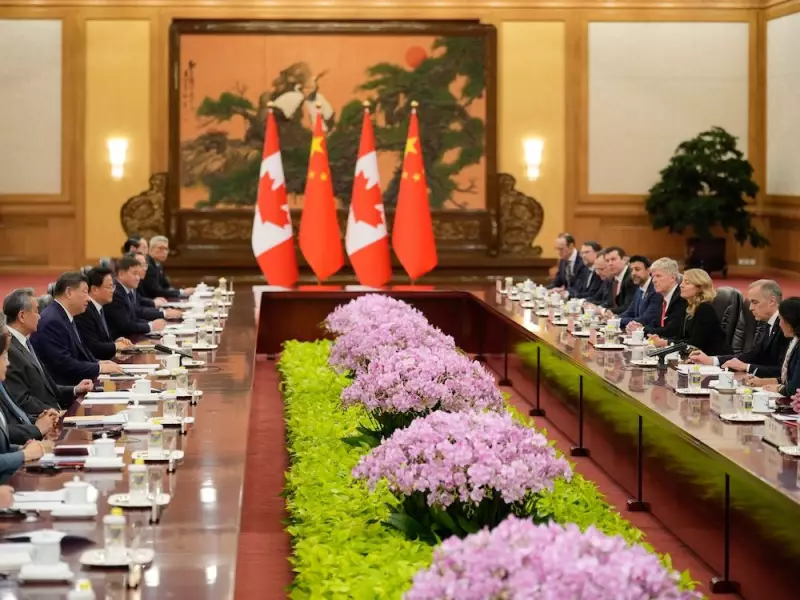
Prime Minister Mark Carney's recent diplomatic mission to Beijing has ignited a fierce debate over Canada's economic strategy and its complex relationship with China. The visit, which took place on January 16, 2026, marked the first trip by a Canadian national leader to the Communist country since 2017. Carney's goals were ambitious: to mend frayed bilateral ties, reduce trade barriers, and negotiate the lifting of restrictive tariffs.
A Strategic Pivot or a Sign of Weakness?
Analysts suggest the impetus for this "consequential and historic" journey, as described by a senior government official, stems from a significant cooling in relations with the United States. Canada's most vital trading partner and the world's largest economy has shown diminishing interest under President Donald Trump. Trump recently dismissed the importance of renegotiating the Canada-U.S.-Mexico Agreement, calling it "irrelevant" and stating he "didn't really care" if a deal was reached.
Faced with this diplomatic chill to the south, Carney appears to have pivoted towards strengthening economic links with China, the world's second-largest economy and Canada's second-biggest trading partner. This shift found support in some quarters, such as a Globe and Mail op-ed by Jacob Cooke, CEO of WPIC Marketing + Technologies in Beijing. Cooke argued for less confrontation and more trade, urging Carney to tap into "untapped trade potential" in sectors like energy, forestry, and minerals.

The Details of the Deal
The tangible outcome of the meetings was a new tariff agreement announced on Friday, January 18, 2026. Canada agreed to grant China a "most-favoured-nation tariff rate of 6.1 per cent" on Chinese-made electric vehicles, a substantial reduction. In return, China committed to lowering tariffs on Canadian canola seed to a combined rate of approximately 15 per cent, effective March 1.
Critics, including commentator Michael Taube, were quick to pounce on the agreement, arguing that China secured a significantly better deal. The reaction from Washington was notably indifferent. When asked, President Trump simply stated, "If you can get a deal with China, you should do that," reinforcing his earlier stance that Canada's trade value to the U.S. was minimal.
Unresolved Conflicts Cast a Long Shadow
The core criticism of Carney's approach centers on timing. Opponents argue that Canada should not be expanding trade with Beijing while years of serious confrontation remain unresolved. The most prominent of these is the Meng Wanzhou affair. Meng, the chief financial officer of Huawei Technologies, was arrested in Vancouver in December 2018 on a U.S. extradition request related to fraud charges concerning violations of Iran sanctions.
This incident, along with other geopolitical tensions, has deeply eroded trust among many Canadians who question China's role as a reliable and honest trade partner. The fundamental lack of faith presents a major hurdle for any prime minister seeking to "reset" the relationship, as Carney aims to do.
The central question now is whether Prime Minister Carney's strategy of engagement can protect Canadian economic interests while standing firm against a powerful counterpart like President Xi Jinping. Or, as critics contend, has the need for an economic alternative to the U.S. led Canada into a premature deal that overlooks critical, unresolved disputes? The success of this diplomatic gamble will unfold in the years of trade and negotiation that follow this historic visit.