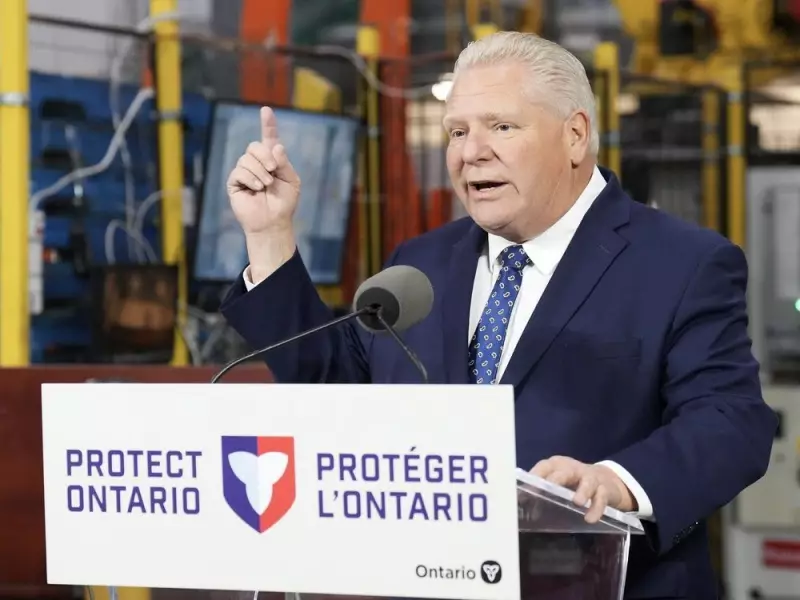
Ontario Premier Doug Ford has expressed strong disappointment over a recent trade agreement between Canada and China, a deal that has simultaneously been met with applause from the Canadian canola industry for providing crucial relief to exporters.
Premier Ford Decries Lack of Consultation on EV Imports
Ford revealed that he and Canadian automakers were given only a few hours' notice before the federal government announced the pact. "I found out about this deal, and the auto companies found out, by the way, a few hours before it was announced, so much for the partnership," Ford stated during a speech on Monday at the Rural Ontario Municipal Association's annual meeting in Toronto.
The core of his concern lies in the agreement's terms on electric vehicles (EVs). The deal allows for the import of 49,000 Chinese-made electric vehicles into Canada at a reduced tariff rate of 6.1 per cent. Ford argues this will force Canadian auto workers to compete unfairly with Chinese labour that earns significantly lower wages.

Expressing a rift in federal-provincial relations, Ford noted he had not spoken directly to Prime Minister Mark Carney since the announcement and was informed of the details by Intergovernmental Affairs Minister Dominic LeBlanc. "We had such a great relationship... but it's all about communication, collaboration and partnership," Ford remarked.
Canola Industry Hails "Landmark" Tariff Reduction
While Ontario's leader voices opposition, the agricultural sector, particularly in Western Canada, is celebrating. The agreement resolves a trade dispute that began in 2024 when Canada first imposed tariffs on Chinese EVs, prompting Beijing to retaliate with severe levies on Canadian canola.
China had imposed a 100 per cent tariff on canola oil and a 76 per cent tariff on canola seed exports. Under the new deal, effective March 1, China will slash its tariff on Canadian canola seed exports to 15 per cent and completely remove tariffs on canola meal. The 100 per cent tariff on canola oil, however, will remain in place.
This reduction is a major victory for Canadian farmers and exporters who depend heavily on the Chinese market.
A Deal Highlighting Regional Economic Divides
The agreement has underscored regional economic priorities within Canada. When asked on CTV's Question Period if the deal pit one region against another, Saskatchewan Premier Scott Moe defended the outcome.
"I disagree with the framing of that question," Moe said. "The agriculture industry, the canola industry, the oilseed industry... is important to virtually each and every part of this country, up to and including Ontario." He added that the deal would also create opportunities in Canada's energy and manufacturing sectors.
The federal government has positioned the agreement as a net benefit, stating it will drive Chinese joint investment in Canada and provide more affordable EV options for consumers. Officials noted that about 50 per cent of the imported vehicles are expected to be priced under $35,000.
The deal, announced by Prime Minister Carney on Friday, January 19, 2026, continues to generate debate, highlighting the complex balance between supporting Canada's traditional agricultural strengths and navigating the future of its automotive industrial policy.