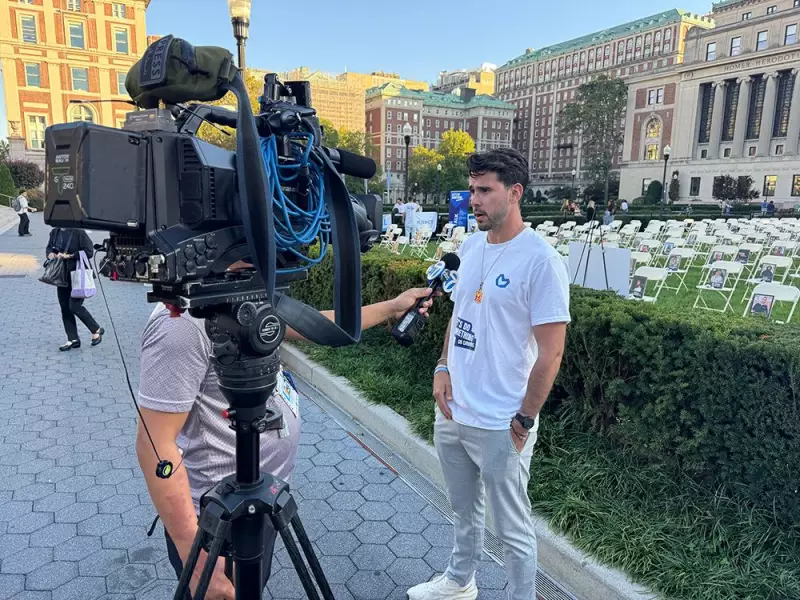
A new advocacy group born from the ashes of the October 7, 2023, Hamas attacks in Israel is launching its first Canadian campus initiative this month at Montreal's McGill University. Let's Do Something was founded by Baruch Apisdorf and friends in the immediate, traumatic aftermath of the massacre, which claimed the life of Apisdorf's best friend.
From Personal Tragedy to Global Movement
The group's origin is rooted in profound personal loss. In the early hours of October 7, Apisdorf received a desperate text from his 25-year-old friend, David Newman. Newman had borrowed Apisdorf's car to attend the Nova music festival in southern Israel and was hiding from Hamas terrorists in a dumpster. His final message, a grim joke asking for prayers for himself and the car, was a haunting farewell. Newman was among the 378 people killed at the festival, a fact Apisdorf and friends confirmed a day later by identifying his body in a photograph of the massacre site.
"A friend reached out for help and I wasn't able to help him," Apisdorf told the National Post. That sense of helplessness became the emotional catalyst for action. Within hours of learning of Newman's murder, Apisdorf and four other twenty-somethings began a group chat that swiftly evolved into a full-scale logistics operation.

Three Pillars: Defence, Healing, and Advocacy
Let's Do Something quickly formalized its mission around three core pillars. Its initial efforts focused on defence and aid. After hearing that friends serving in the Israeli Defense Forces reserves needed basic supplies like sleeping bags, the group emptied their own closets. Word of their efforts spread rapidly. A friend's mother in New York offered her home as a drop-off centre, and within hours, 300 cars lined her street. With the help of an El Al executive who provided cargo space, the group sent its first of ten aid flights to Israel, transporting 20,000 pounds of gear.
The organization has since grown significantly. In Israel, it helps source equipment and technology for soldiers and civilians and is establishing a "defence-tech lab" in Tel Aviv to support startups developing new security tools. Apisdorf frames this work as part of a broader struggle against an Iran-Russia-China axis, noting the same drones Iran sent to Israel are sold to Russia.
The healing pillar is addressed through a fully subsidized PTSD and trauma centre in Thailand, designed to help survivors of the Nova festival and others grappling with the psychological fallout of October 7 and the subsequent Gaza war. "You can't ask people to be advocates for anything if they're still trying to survive their own brains," Apisdorf explained.
Bringing "Proudly Pro-Semitic" Dialogue to Canadian Campuses
It is the third pillar—advocacy—that is now bringing Let's Do Something to Canada. The group describes itself as the "first ever proudly pro-Semitic movement by the youth, for the youth." It has built a massive social media presence on platforms like Instagram, TikTok, and YouTube, claiming to have engaged over 100 million people with emotionally driven, documentary-style content about young Israelis and post-October 7 Jewish identity.
This month, that advocacy lands at McGill University in Montreal. Apisdorf notes that many people, especially on campuses, "don't know how to actually engage in" meaningful dialogue about Israel and antisemitism. The group's campus initiative aims to bridge that gap through direct conversation and personal storytelling, moving beyond polarized debates to foster understanding.
From a late-night chat among grieving friends to an international organization with millions of digital impressions, Let's Do Something represents a new generation's response to tragedy. Its expansion into Canada signals a concerted effort to change the narrative and engagement around Israel and Jewish identity on university grounds, starting with one of the country's most prominent institutions.