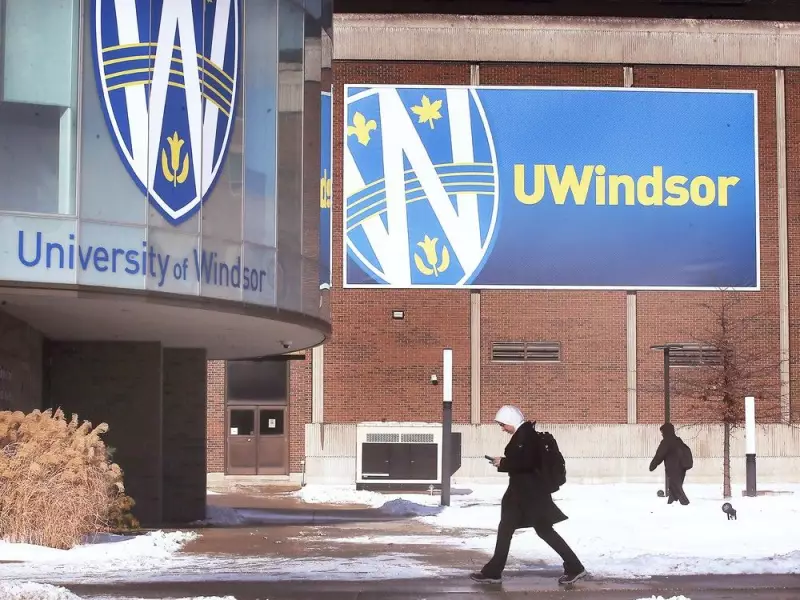
UWindsor President Sounds Alarm on University's Uncertain Future in Provincial Submission
The University of Windsor's recent formal submission to the Ontario government serves as a stark warning about the institution's precarious financial situation, with President J.J. McMurtry characterizing it as a "plea" for urgent governmental intervention to address critical funding needs.
A Province-Wide Problem for Post-Secondary Institutions
In a detailed conversation with media representatives, McMurtry emphasized that the funding challenges facing the University of Windsor reflect a broader systemic issue affecting post-secondary institutions across Ontario. "We were trying to say calmly but with urgency that we need the government to step up to support the university sector," McMurtry explained, highlighting the gravity of the situation facing higher education in the province.
The university's formal submission to the Ministry of Colleges, Universities, Research Excellence and Security (MCURES), dated October 31, 2025, presents a sobering assessment of the institution's future prospects. The document explicitly states that the university is "confronting a future in which it may no longer be viable" as a combination of factors places unprecedented strain on its financial stability.

Structural Funding Challenges and Their Consequences
McMurtry pointed to several key factors contributing to the funding crisis:
- The Ontario government's 10 percent tuition reduction for domestic in-province students implemented in 2019
- The ongoing tuition freeze that has persisted since that initial reduction
- Recent federal decisions limiting international student enrollment
According to data from the Council of Ontario Universities, these policies have collectively deprived universities of hundreds of millions of dollars in essential revenue. "I think we've done as good a job, if not a better job, than any other university in Ontario in trying to find efficiencies," McMurtry noted. "But the reality is that if there is not a structural change in how the government funds universities... then the challenges are significant for the university sector."
Financial Impact and Institutional Response
The university faces particularly severe financial pressures, with projections indicating a revenue decline exceeding $30 million for the 2025-2026 academic year. This follows a $14 million revenue shortfall from the previous year, which university documents attribute "primarily to significant international enrolment changes."
Former University of Windsor President Robert Gordon detailed the institution's response to these challenges in official communications. "We have explored every resource and avenue to optimize efficiencies, reduce costs, and strategically allocated funding, while still allowing us to fulfill our core mission," Gordon wrote in university documents.
The university has implemented several difficult measures to address the financial shortfall:
- Personnel reductions across various departments
- Salary and hiring freezes affecting staff and faculty positions
- Operational restructuring to streamline university functions
Through these efforts combined with one-time funding from MCURES, the university managed to reduce what was initially a substantial funding gap to a "more manageable" $4.6 million. However, McMurtry emphasized that such temporary measures cannot address the underlying structural issues facing the institution.
The Broader Implications for Ontario's Education System
The situation at the University of Windsor represents what McMurtry describes as a province-wide problem requiring immediate attention from policymakers. The reduction in international student enrollment, which had previously helped offset funding shortfalls from domestic tuition policies, has created what McMurtry called "a very significant impact on our financial bottom line."
As Ontario's post-secondary institutions grapple with these interconnected challenges, the University of Windsor's cautionary submission serves as a bellwether for the entire sector. The institution's leadership has made clear that without substantive changes to how universities are funded in Ontario, the long-term viability of these crucial educational institutions remains in serious question.

"We have to acknowledge this reality," McMurtry stated emphatically, underscoring the urgent need for collaborative solutions between educational institutions and government bodies to ensure the continued strength of Ontario's higher education system.