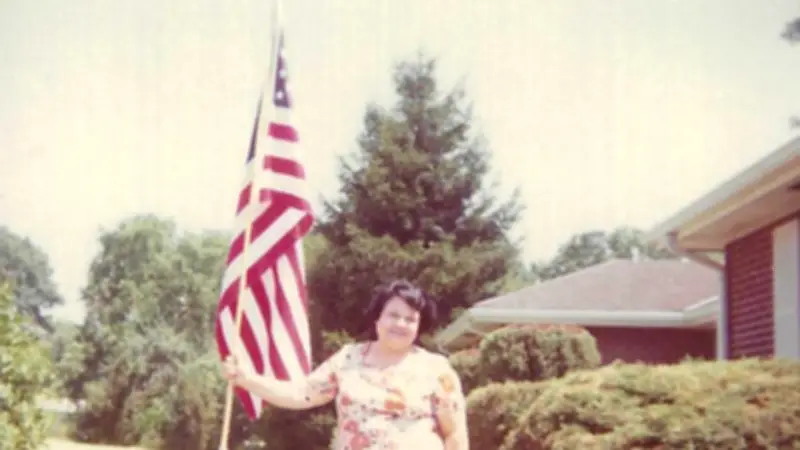
My mother, Mary Louise, was born on July 4, 1913, the first child of Italian immigrants in the United States. She believed the Founding Fathers had personally orchestrated her birth. To her, Independence Day was a national celebration held in her honor, complete with parades, sparklers, fireworks, and patriotic songs. Every year, we had to photograph her standing proudly beside the American flag.
A Childhood Split Between Two Countries
Shortly after her birth, my pregnant grandmother left my grandfather and returned to Italy with my infant mother and toddler aunt. They lived there for 12 years, enduring World War I and a pandemic. When my grandfather finally convinced my grandmother to return to America, he was reunited with three daughters aged 11, 12, and 13—none of whom he knew or spoke English. My mother, however, was thrilled to be back, relishing that she was the only sister born in America, undisputed proof of her U.S. citizenship.
In Catholic school, the nuns placed my mother and her sisters with second graders because they didn't know what to do with adolescent girls who spoke no English. When Mary shouted a math answer in Italian, the younger children laughed. Humiliated, she quit school entirely.

Accents and Assumptions
My two aunts finished high school without accents, but my mother never lost hers. Nothing offended her more than assumptions based on her speech. If anyone questioned her origins, she'd fire back, “I wassa born in dis country! I’mma United States-a citizen!” Despite misperceptions, she never lost faith in America's promise—a land where dreams come true through hard work and partnership.
She married a man who also grew up in Italy and was willing to work hard. My father attended bricklayer school, learned his trade, and became a determined mason. He laid brick for others all day, then came home to build our future house. My brothers and mother mixed mortar and handed him supplies until dark, while other families watched TV. It took him two years to build our home, brick by brick.
Fitting In and Feeling Different
Our new neighborhood had names like Pfeiffer, Shafer, and Herr—and then the Tunnos. Both neighbors built fences along our property line, unlike anyone else. My father, bewildered, asked, “What did they think we were going to do?” My parents decided not to teach us Italian, hoping we'd fit in. Still, I felt different with my frizzy brown hair and brown eyes, unlike the blonde, blue-eyed girls in ads. By fourth grade, I spent hours straightening my hair to look like them.
I didn't notice the sideways glances my mother received, but she did. As a teenager, I began judging her too—the glances, assumptions, judgments, and fences spoke volumes. I thought we'd moved past that, but as America approaches its 250th anniversary, it feels like we're slipping backward.
Learning from Differences
When I had children, I hoped they'd grow up feeling like “real” Americans, unlike me or my mom. We lived in Glendale, California, where about 30% of the population is Armenian and the rest a mix of nationalities. My kids felt “other” too, but for different reasons. In hindsight, that was beneficial. They grew up surrounded by diverse ethnicities and backgrounds, learning to bond over commonalities and celebrate differences. Many families became close friends, sharing foods and customs that enriched our lives.
I'm grateful my children learned that different doesn't mean scary or worse—it just means someone has a story you haven't heard. I can see the division, finger-pointing, and ugliness still present in our nation, prodded by politicians. My parents would be disappointed, but like my mom, I refuse to lose belief in America's promise.
I still believe what makes America great is that we are all different yet together, trying to give our kids a better life. We may not agree on the path forward, but if we stop, listen, and respect each other, we can begin to understand and learn. This year, watching fireworks on our 250th birthday, I'll remember my mother's faith in America. Progress takes time—and it's worth fighting for. I know this country is too.
After more than two decades in our childhood home, Mr. Pfeiffer told my dad he regretted building that fence, which made my father smile. Progress takes time—and it's worth fighting for.