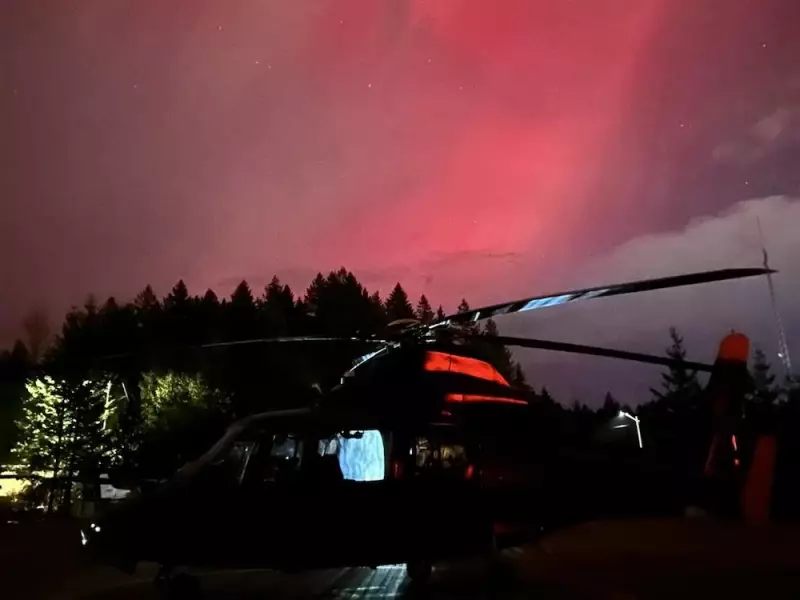
The night skies over British Columbia have been putting on a spectacular show this week, with Tuesday's Northern Lights display captivating residents across the province. What made the celestial performance even more remarkable was that it served as the backdrop for a dramatic rescue operation in Squamish.
Dramatic Rescue Under Dancing Skies
While the Aurora Borealis painted the heavens, Squamish Search and Rescue responded to an emergency call about a BASE jumper who had crashed into a cliff face on Slhanay near Squamish on Tuesday night. The 25-member team located the individual perched on a small rock feature approximately 60 feet below the edge—wet, cold, but conscious. North Shore Rescue and Talon Helicopters provided helicopter assistance to hoist the injured jumper to safety, all under the mesmerizing glow of one of the most beautiful Northern Lights displays in recent memory.
The Science Behind the Spectacle
The breathtaking light show we've been witnessing has a scientific explanation that dates back to Norwegian space physicist Kristian Birkeland, who first deduced the source of these awesome night sky displays. From ancient times to Galileo and modern science, the Northern Lights have continued to captivate human imagination.

Solar storms on the sun's surface release charged particles that form what scientists call a "solar wind." This stream of particles impacts Earth's magnetic field, funneling most toward the polar regions. When these high-energy particles interact with gases in our upper atmosphere, they cause photons to be released—creating the light we recognize as the Aurora Borealis.
Understanding the Colors of the Aurora
The different colors visible during Northern Lights displays result from interactions between solar particles and various atmospheric gases at different altitudes. The most commonly seen green hue comes from oxygen being "excited" between 100-300 kilometers above Earth. Oxygen can also produce red colors at higher altitudes between 300-400 kilometers.
Nitrogen creates pink or dark red fringes along the lower edge of an aurora at around 100 kilometers, while hydrogen and helium interactions produce blues and purples. However, these latter colors can be difficult to spot with the naked eye against the night sky.
Why This Week's Display Has Been Exceptional
Tuesday night's particularly vibrant display resulted from a solar storm ranking three out of five on the Geomagnetic Storm Scale. Category three storms are considered "strong" and can potentially affect power grids and digital devices. We are also currently experiencing the peak of an 11-year solar cycle, during which the sun's magnetic field flips and activity on the star's surface increases.
Social media platforms were flooded with spectacular images from across B.C. and the Lower Mainland, and forecasts suggest Wednesday and possibly Thursday nights might offer even better viewing opportunities.
Capturing the Perfect Aurora Photo
For those hoping to photograph the Northern Lights, experts recommend using a tripod and setting your camera to manual mode. Longer exposure times between 5-15 seconds typically work best, along with higher ISO settings and wide aperture lenses. Finding locations away from city light pollution significantly improves both viewing and photographic results.
The combination of increased solar activity and clear weather conditions creates perfect circumstances for British Columbia residents to witness this natural wonder. As the solar cycle continues toward its peak, night sky enthusiasts anticipate more frequent and vibrant displays throughout the coming months.