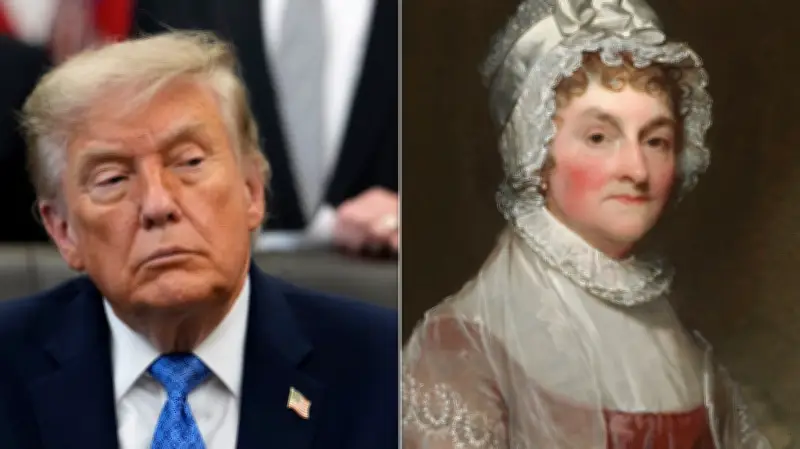
As Americans prepare for the 250th birthday festivities for the United States, the MAGA-affiliated Freedom 250 website has launched AI-generated portraits of Revolutionary War figures that historians say are deeply inaccurate and homogenized. The portraits, posted on the site's history page, feature historical figures with near-identical blue clothing, strikingly similar faces, and only four women noted as “the ladies of the revolution.”
Criticism of Abigail Adams Portrait
User @guttersniper on X wrote, “This is not Abigail Adams. This is an AI generated image that looks nothing like the portraits of her that exist and were painted from life. It’s from the White House’s Freedom 250 web site.” Another user, @OlympicChenpion, invoked the term “yassified” to describe excessive beauty filters, noting the portrait made Adams look like a “Disney princess” with a “laughable attempt at 18th century dress” resembling a “community theatre production of 1776.”
Expert Concerns on Beautification and Misogyny
Kari Winter, professor of global gender and sexuality studies at the University of Buffalo, told HuffPost, “The faces of the women are obvious products of AI created for purposes of beautification rather than information. They function to reinforce the administration’s misogynistic ideology.” She added, “If women’s value is defined by their appearance, all historically significant women must have been beautiful in a cookie-cutter way unmarked by the passage of time and the struggles of existence.” Winter also noted that many men’s faces are identical, calling it a “cut-and-paste hatchet job” where “real historical people in their gritty specificity do not matter.”

Impact on Historical Understanding
Isabel Roughol, host of Broad History podcast, told HuffPost that such inaccuracies risk sidelining women and marginalized groups. “A lot of work has been done in the last half century to resurface the stories of women,” she said. “The thing with the Freedom 250 site, they didn’t think very far.” Roughol emphasized the need to ask “who are we forgetting?” and cited Carole Berkin’s “Revolutionary Mothers” as an example of telling broader stories, such as women leading boycotts of tea and linens during the revolution.
AI Limitations and Misrepresentation
Roughol noted that AI is not trained on historically accurate images: “If you prompt AI to just picture a woman, it will give you thin, young, white, wealthy women.” She added that the costumes in Freedom 250 portraits look like they are from the “Gilded Age” rather than the 18th century. “It is presented as something that is scholarly and accurate,” she said. “That’s what bothers me the most.” She contrasted this with historical entertainment like “Bridgerton,” which audiences know is not a history lesson.
Recommendations for Accurate History
Winter called the Freedom 250 narrative “propagandistic: a cesspool of disinformation, misinformation and fakery,” urging readers to turn to real historical sources. Both experts recommended books including Amanda Vaill’s “Pride and Pleasure,” Carol Berkin’s “Revolutionary Mothers,” Russell Shorto’s “Revolution Song,” Stacy Schiff’s “The Revolutionary: Samuel Adams,” Annette Gordon-Reed’s “The Hemingses of Monticello,” and David Waldstreicher’s “The Odyssey of Phillis Wheatley.” Winter also recommended Ken Burns’s PBS series “The American Revolution” (2026).