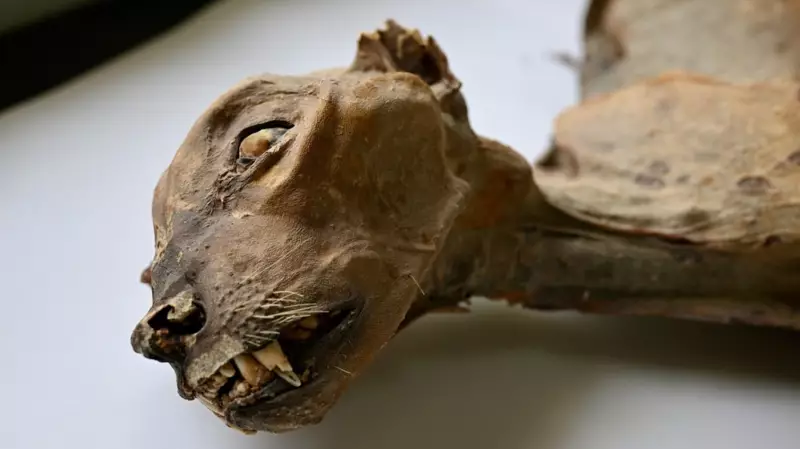
In a discovery that rewrites our understanding of the region's ancient wildlife, researchers have unearthed the naturally mummified remains of cheetahs from caves in northern Saudi Arabia. The find includes seven complete mummies and the bones of 54 other individuals, with ages ranging from 130 to over 1,800 years old.
A Rare Glimpse into an Ancient World
The excavation site near the city of Arar yielded an unprecedented collection of large cat remains. The mummies, with their cloudy eyes and shriveled limbs, are preserved as dried-out husks. "It's something that I've never seen before," remarked Joan Madurell-Malapeira, a paleontologist from the University of Florence in Italy who was not part of the research team. The study detailing the find was published in the journal Communications Earth and Environment.
While Egyptian mummies are famous for intentional preservation, these cheetahs underwent natural mummification. The process, which prevents decay, can occur in environments like glacier ice, desert sands, and bog sludge. In this case, the dry conditions and stable temperatures of the caves likely played a crucial role in preserving the animals so completely.

Unanswered Questions and Genetic Clues
Researchers remain puzzled by why so many cheetahs were in the caves. One leading theory suggests the location may have served as a denning site where mothers gave birth and raised their cubs. Another mystery is how the carcasses avoided being scavenged by birds or hyenas, a common fate that typically prevents such intact preservation in large mammals.
In a groundbreaking first for naturally mummified large cats, scientists successfully analyzed the cheetahs' genetic material. The analysis revealed the ancient cats were most similar to modern cheetahs from Asia and northwest Africa. This genetic data is a treasure trove for conservationists. "To find such intact evidence of cheetahs that lived long ago in this part of the world is 'entirely without precedent,'" said study author Ahmed Boug of Saudi Arabia's National Center for Wildlife.
Implications for Modern Conservation
This discovery holds profound significance for wildlife conservation. Cheetahs once roamed across most of Africa and large parts of Asia, including the Arabian Peninsula. Today, they inhabit just 9% of their historical range and have not been seen in Arabia for decades, largely due to habitat loss, unregulated hunting, and prey depletion.
The new genetic information provides a crucial baseline for understanding the lineage of cheetahs that once thrived in the region. This knowledge could directly inform and aid future efforts to reintroduce the cats to areas from which they have vanished. The mummies stand as a stark reminder of a lost ecosystem and offer science a unique tool to potentially help restore it.