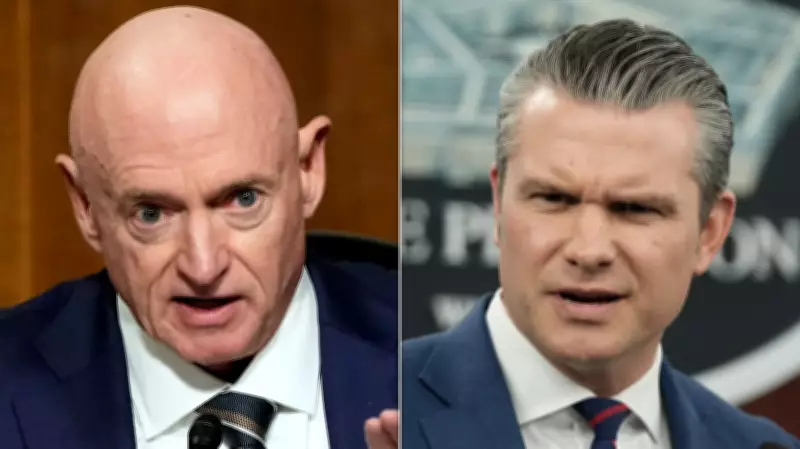
Defense Secretary Pete Hegseth ignited a fierce legal and ethical debate on Friday during a Pentagon press briefing concerning the ongoing conflict with Iran. In a stark declaration, Hegseth vowed that the United States would offer "no quarter" to its adversaries, a statement that immediately drew sharp criticism from Senator Mark Kelly, a Democrat from Arizona, who labeled it as potentially illegal.
Senator Kelly's Swift Rebuttal on International Law
Senator Mark Kelly, leveraging his background as a retired Navy officer, responded swiftly on social media platform X, emphasizing the grave implications of Hegseth's words. "'No quarter' isn't some wanna be tough guy line — it means something," Kelly wrote. He elaborated that such an order would entail refusing to take prisoners and instead killing combatants who surrender, a direct violation of established international humanitarian frameworks.
"An order to give no quarter would mean to take no prisoners and kill them instead. That would violate the law of armed conflict. It would be an illegal order," Kelly asserted. He further warned that this stance could endanger American service members by escalating risks in combat situations.

Hegseth's Controversial Remarks and Historical Context
During the briefing, Hegseth stated, "We will keep pressing. We will keep pushing, keep advancing, no quarter, no mercy for our enemies." Whether intentional or not, the phrase "no quarter" carries a specific legal meaning under international law, prohibiting the killing of surrendering enemies. This principle is enshrined in key documents like the Geneva Conventions and the Hague Convention IV, which explicitly forbid declaring that no survivors will be taken.
Kelly admonished Hegseth, writing, "Pete Hegseth should know better than to throw around terms like this." This incident is not the first time Kelly has been involved in discussions about unlawful military orders. Last year, he and five other Democratic veteran lawmakers released a video reminding U.S. service members of their right to refuse illegal commands, a move that drew backlash from Hegseth and former President Donald Trump.
Broader Implications for Military Policy and Civilian Protection
The controversy unfolds against a backdrop of significant changes within the Defense Department. Since the return of the Trump administration, there has been a notable reduction in federal personnel dedicated to minimizing civilian harm during conflicts. Hegseth himself has expressed a dismissive attitude toward traditional rules of engagement, advocating for a more aggressive approach.
In a recent press briefing, Hegseth remarked, "No stupid rules of engagement, no nation-building quagmire, no democracy building exercise, no politically correct wars. We fight to win, and we don't waste time or lives." This philosophy raises concerns about adherence to international legal standards and the protection of non-combatants.
Human Cost of the Iran Conflict
The war with Iran has already resulted in substantial casualties, with at least 13 U.S. military service members and over 1,400 Iranians losing their lives. Tragically, this includes dozens of schoolgirls killed in an apparent U.S. airstrike on the first day of the conflict, highlighting the devastating human toll and the critical need for stringent adherence to laws of war.
As tensions escalate, the debate over Hegseth's "no quarter" vow underscores deeper issues regarding military accountability, legal compliance, and the ethical conduct of warfare in modern conflicts.