In the lead-up to a major U.S. military offensive against Iran, President Donald Trump was presented with intelligence briefings that starkly outlined the peril of significant American casualties while simultaneously promoting the possibility of a transformative realignment in the Middle East to benefit U.S. strategic interests. This insight comes from a U.S. official who spoke to Reuters on the condition of anonymity, shedding light on the high-risk calculus behind the decision.
Operation Epic Fury Unleashes Regional Turmoil
The Pentagon's initiation of "Operation Epic Fury" on Saturday has plunged the Middle East into a volatile and unpredictable new conflict. Joint U.S. and Israeli forces conducted strikes across multiple sites in Iran, prompting immediate retaliatory attacks from Iran targeting Israel and neighboring Gulf Arab nations. The official described the briefings to Trump as framing the operation within a high-risk, high-reward scenario, a sentiment the president himself echoed in a public address.
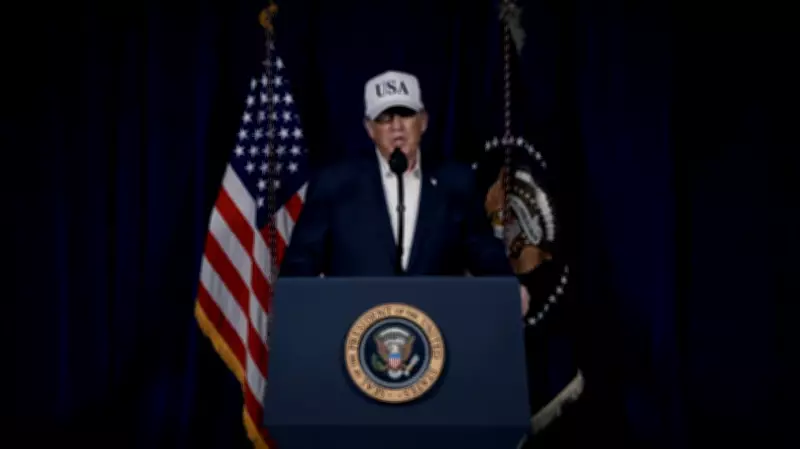
"The lives of courageous American heroes may be lost," Trump acknowledged at the onset of the operation. "But we’re doing this not for now, we’re doing this for the future, and it is a noble mission." In his video announcement, he condemned the Iranian regime's decades-long hostility, stating, "For 47 years, the Iranian regime has chanted death to America and waged an unending campaign of bloodshed and mass murder ... We’re not gonna put up with it any longer."

Behind the Scenes: Briefings and Warnings
The briefings from Trump's national security team provide crucial context for understanding how the president opted to pursue what is arguably the riskiest U.S. military endeavor since the 2003 invasion of Iraq. In the days preceding the strikes, Trump received multiple classified updates from key officials, including CIA Director John Ratcliffe, Joint Chiefs of Staff Chairman General Dan Caine, Secretary of State Marco Rubio, and Defense Secretary Pete Hegseth. Additionally, Admiral Brad Cooper, head of U.S. Central Command, traveled to Washington to participate in discussions within the White House Situation Room.
A second U.S. official revealed that the White House had been extensively briefed on numerous risks associated with targeting Iran. These included the potential for Iranian missile strikes to overwhelm defenses at U.S. bases in the region, as well as attacks by Iranian proxies on American troops stationed in Iraq and Syria. Despite a substantial U.S. military buildup, the official noted limitations in the air defense systems hastily deployed to the area.
Experts caution that the conflict could take dangerous and unforeseen turns. The first official indicated that Pentagon planning did not guarantee a favorable outcome, highlighting the inherent uncertainties. Nicole Grajewski of the Carnegie Endowment for International Peace commented on Trump's call for Iranians to overthrow their government, noting, "The Iranian opposition is pretty fragmented. It’s unclear what the population is willing to do in terms of rising up."
Sweeping Objectives and Escalating Risks
In the weeks leading to the attack, Trump ordered a significant military escalation in the Middle East. Reuters reported on plans for a sustained campaign against Iran, which could involve targeting individual officials. An Israeli official disclosed that strikes aimed at Iran's Supreme Leader Ayatollah Ali Khamenei and President Masoud Pezeshkian, though the results remain unclear.
Trump articulated sweeping goals for the operation, vowing to neutralize the threat posed by Tehran and empower Iranians to topple their rulers. He outlined intentions to decimate Iran's military capabilities, including its missile industry and navy, and to prevent nuclear weapon development. "We are going to destroy their missiles and raze their missile industry to the ground... We’re going to annihilate their navy," he declared. "We’re going to ensure that the region’s terrorist proxies can no longer destabilize the region or the world and attack our forces."

This decision marks a notable increase in Trump's risk appetite, surpassing recent actions such as the raid in Venezuela to seize that country's president and earlier bombings of Iran's nuclear sites. Iran's Revolutionary Guards have threatened all U.S. bases and interests, promising continued retaliation until "the enemy is decisively defeated."
Expert Analysis on Retaliation and Gambles
Security analysts warn that Iran possesses a broad array of retaliatory options, including missile strikes, drone attacks, and cyber warfare. Daniel Shapiro, a former senior Pentagon official for Middle East issues and ex-U.S. ambassador to Israel, emphasized the persistent dangers. "Iran has many more ballistic missiles that can reach U.S. bases than the U.S. has interceptors ... some Iranian weapons will get through," he stated, characterizing the strikes as "a major gamble."
Both U.S. officials who provided information requested anonymity due to the sensitive nature of internal deliberations. The White House did not immediately respond to requests for comment, and the Pentagon declined to offer additional statements.