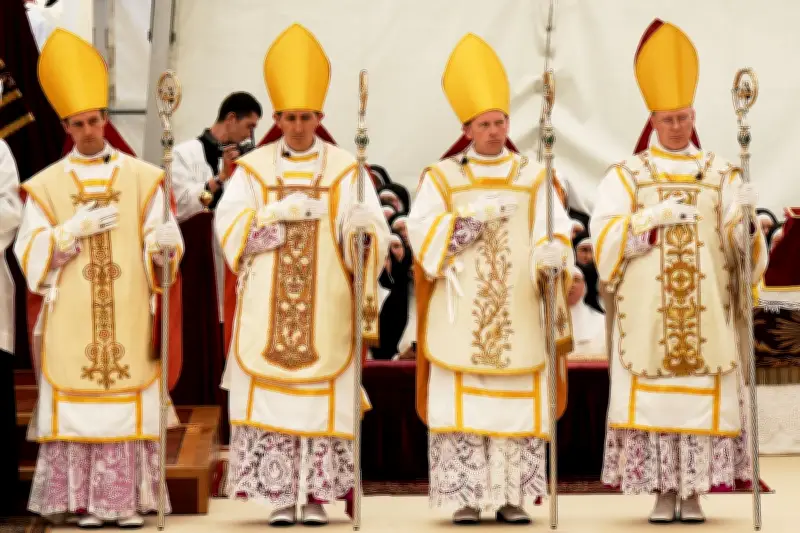
The Society of St. Pius X (SSPX), a traditionalist breakaway group, has been formally excommunicated from the Roman Catholic Church after consecrating four new bishops in defiance of Pope Leo's repeated warnings. The ceremony took place on July 1 at the SSPX seminary in Econe, Switzerland, deepening a rift that has persisted for decades.
Consecration Ceremony and Immediate Aftermath
On Wednesday, July 1, SSPX leaders consecrated Marc Hanappier, Michel Poinsinet de Sivry, Michael Goldade, and Pascal Schreiber as bishops. The Vatican had issued multiple admonitions, including a formal warning from Pope Leo himself, urging the group to abandon the plan. According to a Vatican statement, the consecration constitutes an act of schism, resulting in automatic excommunication for all involved parties, including the consecrating bishop and the newly ordained bishops.
The SSPX, founded by Archbishop Marcel Lefebvre in 1970, has long resisted certain reforms of the Second Vatican Council, particularly those related to liturgy and ecumenism. The group has been in a canonical irregular status since 1988 when Lefebvre consecrated four bishops without papal approval. Despite ongoing dialogue under previous popes, tensions escalated under Pope Leo, who demanded full compliance with Vatican authority.

Pope Leo's Response and Church Authority
Pope Leo, in a statement released by the Holy See Press Office, expressed deep regret over the SSPX's decision. "This act of defiance is a grave wound to the unity of the Church," the statement read. "By choosing to proceed with these illicit ordinations, the Society has placed itself outside full communion with the Catholic Church." The Vatican emphasized that excommunication is not a punitive measure but a recognition of a self-imposed separation from the Church's sacramental life.
The excommunication extends to all bishops who participated in the ceremony, including SSPX Superior General Davide Pagliarani, who officiated. The four new bishops are also automatically excommunicated. The Vatican has called on the faithful to pray for the return of the SSPX members to full unity.
Historical Context and Schism
The SSPX's relationship with the Vatican has been fraught since its founding. In 2009, Pope Benedict XVI lifted the excommunications of four SSPX bishops consecrated in 1988, hoping to foster reconciliation. However, doctrinal talks stalled, and under Pope Francis, the group remained in a canonical limbo. Pope Leo, elected in 2025, took a harder stance, demanding unconditional acceptance of Vatican II and papal primacy.
According to church historians, this excommunication is the most significant schismatic event since the 1988 consecrations. The SSPX claims to have about 600 priests and 200,000 faithful worldwide, though these numbers are disputed. The group operates in over 60 countries, with strongholds in France, Switzerland, the United States, and Latin America.
Impact on the Catholic Church
The excommunication is expected to further polarize traditionalist Catholics. Some may rally to the SSPX, while others may seek reconciliation with Rome. The Vatican has indicated a willingness to continue dialogue but insists that the SSPX must first renounce its defiant actions. "The door remains open for those who wish to return to full communion," the papal statement added.
In response, SSPX leaders issued a statement calling the excommunication "unjust" and accusing Pope Leo of abandoning Catholic tradition. "We will continue to preserve the faith of our fathers, regardless of human decrees," the SSPX said. The group maintains that its consecrations were necessary to ensure the survival of the traditional Latin Mass and Catholic doctrine.
Broader Reactions and Future Prospects
Bishops' conferences worldwide have expressed support for the Vatican's decision. The U.S. Conference of Catholic Bishops called the SSPX's actions "a serious matter that undermines ecclesial unity." Meanwhile, some traditionalist groups have expressed sympathy with the SSPX, though most remain in communion with Rome.

Analysts suggest the excommunication may lead to a permanent schism, with the SSPX operating as a separate church. However, the Vatican hopes that the clear disciplinary action will deter other dissident groups. The situation remains fluid, with potential for further negotiations or a hardening of positions on both sides.