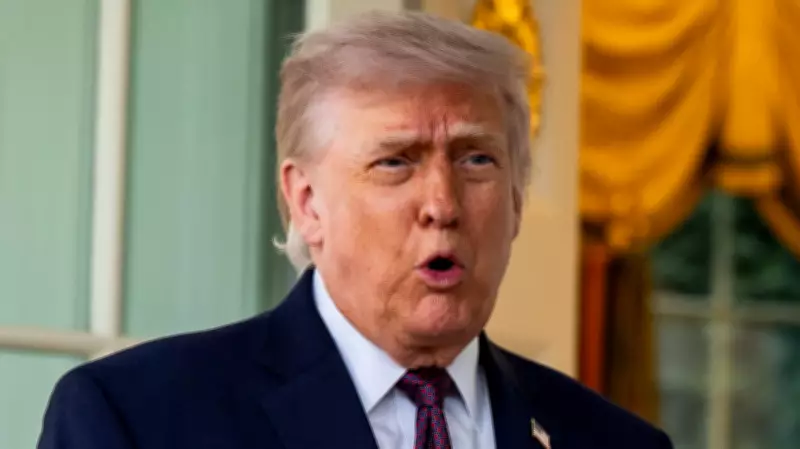
Former Fox News anchor Gretchen Carlson delivered a pointed analysis on CNN this week, asserting that Donald Trump's recent series of controversial religious-themed social media posts convey a deeply troubling underlying message. Speaking with host Erin Burnett, Carlson dissected the imagery and its potential implications for Trump's political narrative.
Trump's Controversial Posts Spark Outrage and Analysis
The controversy ignited when Trump initially shared an AI-generated image depicting himself as Jesus Christ healing a sick individual. This post was made concurrently with his attacks on Pope Leo, drawing swift and widespread condemnation from across the political spectrum. The backlash was so intense that Trump ultimately deleted the image, later offering the peculiar explanation that he believed it made him resemble a doctor rather than a religious figure.
A Follow-Up Post Doubles Down on Religious Imagery
Undeterred, Trump posted another provocative image on Wednesday. This one featured a Jesus-like figure warmly embracing Trump, accompanied by the caption: “The Radical Left Lunatics might not like this, but I think it is quite nice!!!” Carlson interpreted this second post as a strategic escalation. “Maybe it’s not appropriate for me to actually be Jesus but I will be right next to him and he will be hugging me,” she suggested, paraphrasing what she believes Trump's intent might be.

Carlson Warns of 'Deep Implication' in Messaging
Carlson elaborated on the perceived subtext, stating, “The deep implication here, of course, is that he is either an equal to Jesus or a very, very close friend.” She emphasized that this is not an isolated incident but part of a deliberate narrative. “I do think that there’s a deeper meaning here because he’s continuing down this storyline,” Carlson continued. “Some of his supporters do think of him as a savior, of sorts — and so now he’s continuing to push that imagery out there.”
A 'Scary' Trajectory in Political Discourse
Expressing concern over the broader context, Carlson highlighted recent events that amplify the message. “I think it’s a little scary, quite honestly, that we’re at a point now where just three weeks ago his spiritual adviser called him Jesus, and there was no admonishment of that — and now he’s continuing down this path,” she said. This pattern, she argued, raises alarming questions about the direction of political rhetoric and iconography. “Where do we end up with this?” Carlson pondered, leaving the audience to consider the potential consequences of such messaging in the public sphere.
Carlson's analysis underscores a growing unease among commentators regarding the blending of religious symbolism with political identity, particularly in the age of AI-generated content. Her remarks reflect a critical examination of how imagery can be leveraged to reinforce narratives of divinity or exceptionalism within a political framework.