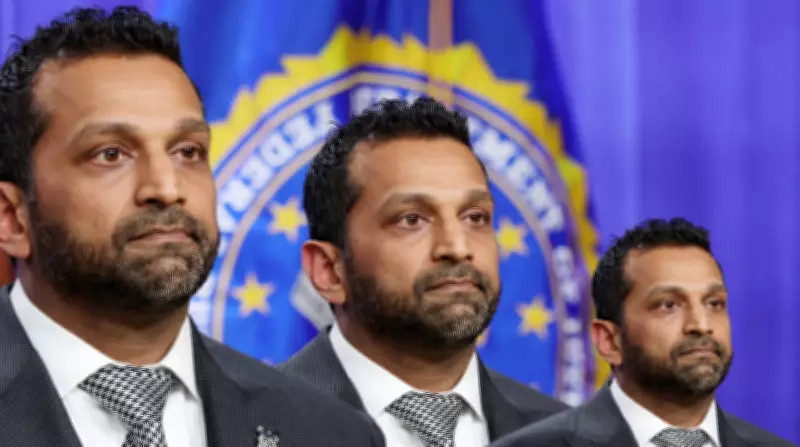
Democrats Demand FBI Director Take Alcohol Screening Test Amid Conduct Complaints
In response to mounting complaints about FBI Director Kash Patel's conduct, Democrats on the House Judiciary Committee have formally requested that Patel complete a 10-question alcohol screening test. However, medical experts emphasize that the results of such a test would not formally constitute a diagnosis of alcohol use disorder.
Understanding the AUDIT Screening Tool
Dr. Joshua Lee, a clinician-researcher specializing in addiction and a professor at NYU's departments of Population Health and Medicine/General Internal Medicine and Clinical Innovation, explained to HuffPost that the Alcohol Use Disorders Identification Test (AUDIT) serves as a screening instrument rather than a definitive diagnostic tool.
"It is a way for me to talk to you and get a sense for the likelihood of an actual alcohol use disorder," Lee stated. "It is akin to something you'd fill out about whether or not you had depression, but I can't diagnose and treat depression until I have further interviewed the patient."

Since its publication in 1989, AUDIT has become the most widely used alcohol screening test globally. Developed by the World Health Organization, this 10-item questionnaire assesses:
- Alcohol consumption patterns
- Drinking behaviors
- Alcohol-related problems
The test is publicly available in two formats: one administered verbally by a medical professional and a self-reported version. Patel would have the option to choose between these two formats.
How the Screening Process Works
The AUDIT questionnaire includes questions such as:
- "How often during the last year have you found that you were not able to stop drinking once you started?"
- "How often during the last year have you needed a first drink in the morning to get yourself going after a heavy drinking session?"
Each answer corresponds to a specific number of points, which are totaled at the end of the assessment. "There's a reliable correlation between high scores on AUDIT and severity of an eventual diagnosis, so it's very helpful," Lee noted.
However, AUDIT scores alone cannot determine a diagnosis. The individual taking the test must agree to further consultation with medical professionals before any formal diagnosis can be made. "The test itself, with its scoring, does not say 'this person could be an alcoholic' by any means," Lee clarified. "We haven't made the diagnosis. We still have to do further testing."
Limitations and Ethical Considerations
While proven helpful, the AUDIT test relies heavily on the test taker's honesty. Some individuals might provide inaccurate responses about their alcohol consumption. "You could downgrade your use of alcohol ... and then you would have a lower score when, in fact, the kind of truth would be that you have a high score and more problems," Lee explained. "But it would be up to you to answer truthfully. If you have the person's real test result, it's a great foundation for talking to an individual about their alcohol use."
The committee, led by Representative Jamie Raskin (D-Md.), has also requested that Patel submit a sworn statement validating the accuracy of his answers by 5 p.m. Eastern Time on April 28.
Legal and Ethical Context
Employers are legally permitted to conduct alcohol testing on employees when there's reasonable suspicion that alcohol use is affecting job performance. As FBI director, Patel is accused of potentially violating the Department of Justice's Ethics Handbook, which prohibits employees from "habitually using alcohol or other intoxicants to excess" both on and off duty.
According to the Judiciary Committee's letter to Patel, "a damning and explosive report recently revealed that the men and women of the Federal Bureau of Investigation (FBI) are privately — and at times publicly — alarmed by your 'episodes of excessive drinking and unexplained absences.'" This reference points to an April 17 story published by The Atlantic.

Should Patel take the test, the results would likely remain confidential under laws such as the Health Insurance Portability and Accountability Act (HIPAA). Democrats have only requested that Patel share his answers with Congress, not with the public.
Potential Consequences and Political Implications
The committee's letter did not specify what actions might follow if Patel scores highly on the test. However, it stated that should he refuse to take the test or submit the findings, "the Committee will be requiring him to appear at a hearing in person and under oath to address Members' well-founded concerns."
Patel has publicly denied drinking on the job, defending his actions during a Justice Department press conference on Tuesday. He referenced footage showing him drinking a beer with the U.S. men's ice hockey team after their gold medal victory at the Winter Olympics. "I've never been intoxicated on the job, and that is why we filed a $250 million defamation lawsuit," Patel declared.
The FBI director has sued The Atlantic for $250 million, claiming the publication printed "false and obviously fabricated allegations" against him. The Atlantic has maintained that it stands by its reporting.
House Minority Leader Hakeem Jeffries (D-N.Y.) indicated on Tuesday that Democrats hope to remove Patel from his position, suggesting he might follow other recent administration departures. "Any one of you that wants to participate, bring it on," Patel challenged his critics. "I'll see you in court."