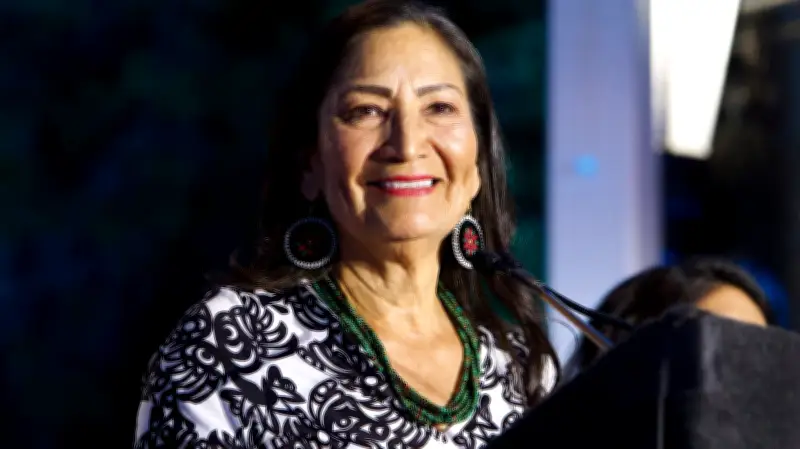
Deb Haaland has spent her career measuring America’s promises against what it has actually delivered to the people who were here first. As the country marks 250 years of independence, she’s doing that math again — this time from the campaign trail, where she’s running to become the first Native American woman governor in United States history.
A Legacy of Generosity
Haaland, who made history in 2021 when she became the first Native American to serve as a Cabinet secretary, spoke with HuffPost about America’s 250th anniversary and how the 4th of July feels different this year, though not necessarily celebratory. Asked what she thinks of when she thinks about what her ancestors gave to America and what they received in return, one word came to mind.
“What comes to mind first is generosity,” she said, describing how generations of Pueblo Indians in the Southwest cultivated the desert long before modern irrigation, and passed that knowledge down rather than hoarding it. “They kept their agricultural tradition alive, they passed it on to generations and generations. They were so, so generous with their knowledge about how to care for the land and the water, and it made New Mexico this beautiful, cultural agricultural state,” she added.

It’s a legacy she says is baked into New Mexico itself — the state’s signature red and green chile cuisine, she said, is a fusion found nowhere else, born from Indigenous and Spanish traditions layered over centuries. But that generosity has often gone unreturned, she says.
Boarding Schools and Erasure
As Interior Secretary under President Biden, Haaland launched a federal initiative documenting the U.S. government’s Indian boarding school era, giving survivors and descendants recognition and a platform to speak about the decades-long assimilation policy that separated thousands of Native children from their families. Her efforts to acknowledge a painful piece of history and find a path to healing for Indigenous communities is one she said is sharply at odds with President Donald Trump’s approach.
In the early months of Trump’s second term, federal websites temporarily scrubbed references to Native code talkers and Tuskegee Airmen, while many women and minorities have been pushed out of federal jobs as the administration has targeted DEI-related roles and agency initiatives.
“That is not in line with what our 250th anniversary of this country should be,” she said. “We should be celebrating all the people who sacrificed so that our country could be here today.”
Immigration and Land Acknowledgments
The erasure she described under the current administration is not limited to Native history. Haaland, whose father was a third-generation Norwegian American, connected her own family’s immigrant roots to her concerns about the administration’s “equally as disturbing” immigration policy.
Asked what she would want Americans to consider — whether they’re grilling in the backyard or watching fireworks — as they mark the country’s 250th, Haaland circled back to a simple point: remember whose land you’re on. She noted the land acknowledgment Valerie Jarrett, Obama Foundation CEO and former adviser to President Barack Obama, gave last month at the dedication ceremony of the Obama Presidential Center. Haaland pointed to the acknowledgement, which honored Chicago’s first inhabitants, as an example worth following, even as she recognized some Native people see such gestures as insufficient.
“I know that some Native folks feel like it’s too little, too late — I appreciate it,” she said. “I think we should always think about whose land we’re on. It wasn’t always the United States. There were thousands of thriving communities across the United States long before any ‘explorers’ ever came to this side of the hemisphere.”
Haaland continued, “I am here because they persevered, and I think Native folks across the country recognize that they’re where they are because they persevered. And not without a lot of sacrifice, violence, you know, all of the things that they survived through. They tried to eradicate every single Native American person in this country, and they failed at it.”

From Voter Registration to Governor Race
That history of persistence is inseparable from her own political origin story. Haaland got her start in politics registering Native American voters in Indian Country. Native Americans weren’t granted U.S. citizenship until 1924, and in New Mexico, they couldn’t vote in state elections until 1948. As for her own Fourth of July plans, Haaland won’t be watching fireworks from the National Mall, as she did during her time in the Biden administration. She’ll be at a parade in New Mexico, she says, handing out campaign buttons and stickers from a float.
It’s a typical campaign trail day for a candidate, but an extraordinary chapter within the historical arc — 250 years ago, the Declaration of Independence described Native Americans as “merciless Indian Savages.” Today, one of their descendants could become the first Native governor in New Mexico’s history, and first Native American woman governor in the history of the U.S.