Pope Leo XIV traveled to the Sicilian island of Lampedusa on Saturday, July 4, to honor tens of thousands of migrants who have died crossing the Mediterranean, in a pointed contrast to the United States' Independence Day celebrations. The first U.S.-born pope prayed at a migrant cemetery and celebrated a solemn Mass for residents and new arrivals, using the visit to underscore the Christian obligation to uphold the dignity of every human being, especially migrants and the vulnerable.
Lampedusa: Epicenter of Europe's Migration Crisis
Lampedusa, a treeless strip of rock 9 kilometers (5.6 miles) long, lies closer to Africa than the Italian mainland and serves as the primary port of entry into Europe for hundreds of thousands of migrants crossing from Libya or Tunisia, often with the help of human traffickers. The island has become Ground Zero of Europe's migration debate as the continent struggles to balance border security with legal obligations to welcome refugees fleeing conflict, climate change, and poverty.
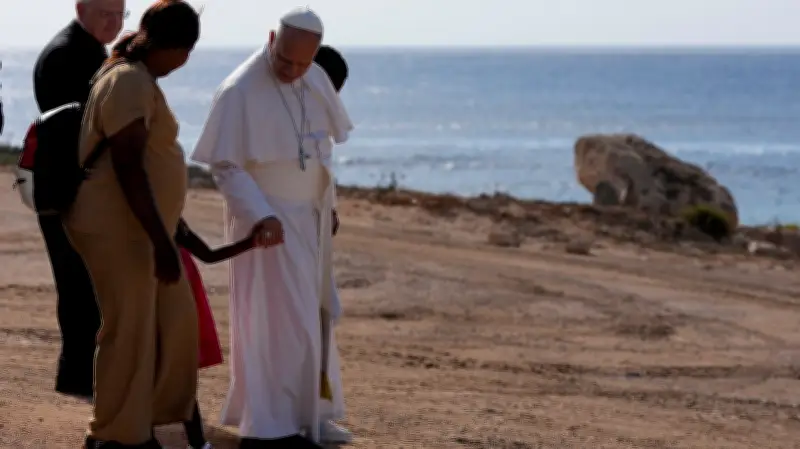
Pope Leo met with migrants at the port and walked alone onto the jagged jetty rocks, his cassock whipped by the wind and his zucchetto skullcap blown off as he gazed out to sea. He blessed a plaque dedicating the dock to Pope Francis, who visited in 2013, before celebrating Mass on land. “This is a place where gestures speak louder than words,” Leo said. “But for gestures to be human, they need a heart.”

A Powerful Symbolic Message to the United States and Europe
By choosing July 4 for the visit, Pope Leo sent a powerfully symbolic message to the United States and Europe. In a letter to Americans on the 250th anniversary of the Declaration of Independence, he insisted that protecting the unborn and all human life also means “welcoming, protecting and assisting immigrants, whose hopes, sacrifices and contribution have formed part of the history of this country from its very beginning.” “To receive them with compassion and generosity is not only an act of charity, but also a recognition of the dignity that belongs to every human person,” Leo wrote.
In his homily, Leo thanked Lampedusa's residents for the “miracle of compassion” they have shown in welcoming migrants and urged Europe to rise to the challenge. “Indeed, before any intellectual consideration or ideological conviction, the encounter with those who lie before us, stripped of everything, calls us to be close to them,” he said, wearing vestments decorated with images of waves. Preaching from “this far-flung corner of Europe on the Mediterranean Sea,” Leo urged European leaders to address migration comprehensively, integrating immediate relief with long-term strategies to receive, protect, support, and integrate migrants while developing their home countries so no one is forced to migrate.
Migrant Arrivals and Deaths at Sea
The number of migrants arriving in Italy so far this year is significantly lower than in recent years, with the Interior Ministry reporting 14,464 arrivals as of Friday compared with 30,598 in the same period last year and 26,202 in 2024. However, the International Organization of Migration (IOM) has recorded more than 35,000 missing migrants in the Mediterranean since 2014, though the actual number of dead is believed to be far higher given the untold number of “invisible” shipwrecks that are never recorded.
Salvatore Sortino, the IOM's head of mission for Italy and Malta, noted that despite the decrease in arrivals, the number of dead had increased proportionally. “That speaks about the vulnerability that remains,” he said. “So the visit of the pope here, where all this happens, I think is a very important reminder of that element.”
Pope Leo's Emphasis on Migrant Dignity
Pope Leo has strongly emphasized the need to uphold the dignity of migrants, especially amid the Trump administration's mass deportation program in his native Chicago. He has also directed his message to Europe's Christian leaders. Last month, he visited another European migration hot spot, Spain's Canary Islands, to shame leaders who turn migrants away indifferently while warning people smugglers they will face God's wrath for exploiting the desperation of migrants.

After arriving in Lampedusa by plane, Leo paid homage to the dead at the island's migrant cemetery, laying a wreath of yellow and white flowers on their graves, marked by simple crosses made from the splintered wood of shipwrecked boats. Tareke Brhane, a migrant from Eritrea and president of the October 3rd Committee, a nonprofit founded by relatives of victims of a 2013 shipwreck in Lampedusa that left 368 people dead, said the gestures send a “strong message” of solidarity. “It is a strong sign for our battle with Italy and with Europe in order to register the deaths, because as of today we still do not have a registry (of those deceased),” he told the Associated Press. Leo's visit both honors the dead and “gives a message to the relatives, so many of them still waiting and suffering,” he said.
Following in Pope Francis's Footsteps
With his visit, Leo followed in the footsteps of Pope Francis, who made the plight of migrants and refugees a priority of his pontificate. For the Catholic Church, welcoming and accompanying people fleeing hardship is part of the Gospel-mandated call to “welcome the stranger.” Francis traveled to Lampedusa in July 2013, on his first trip outside Rome after his election, tossing a wreath into the sea in memory of migrants who had died and denouncing the “globalization of indifference” that the world shows migrants.