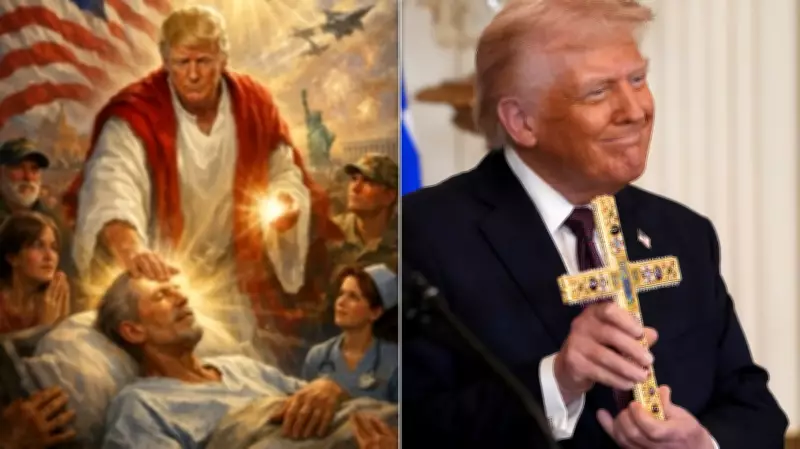
Trump's AI-Generated 'Healing' Image Ignites Religious Firestorm on Orthodox Easter
An artificial intelligence-generated image portraying former President Donald Trump as a divine healer, with light emanating from his palms and an American flag in the background, has triggered widespread outrage among religious communities. The controversial post, which circulated on Orthodox Easter Sunday, was later removed, but not before drawing sharp criticism from leaders of various faiths, including some of Trump's own advisers.
Divine Portrayal Sparks Immediate Backlash
The image, originally shared by Trump's special envoy Nick Adams over two months ago, resurfaced when Trump himself reposted an altered version on his Truth Social platform. In a brief White House statement on Monday, Trump defended the post, claiming it depicted him as a doctor with Red Cross associations. "I did post it. I thought it was me as a doctor, and had to do with Red Cross, there's a Red Cross worker there, which we support," Trump stated. "Only the fake news could come up with that one."
This incident followed closely on the heels of another controversial post in which Trump denounced Pope Leo as "weak on crime," creating a particularly polarizing weekend for the faith communities that have historically supported him. The image has since disappeared from Adams' social media account, marking a rare removal from feeds typically filled with provocative content.

Religious Leaders Unite in Condemnation
Bishop Robert Barron, a member of Trump's Presidential Religious Liberty Commission, expressed disapproval while maintaining respect for the president's religious work. On social media platform X, Barron wrote: "The statements made by President Trump on Truth Social regarding the Pope were entirely inappropriate and disrespectful. They don't contribute at all to a constructive conversation."
Protestant leaders adopted an even stronger stance. Amanda Tyler, executive director of the Baptist Joint Committee on Religious Liberty, told HuffPost: "When the president of the United States posts an image of himself in the role of Jesus Christ, he is not expressing personal faith. He is claiming that his authority is divine. That is not a religious statement. It is a political one — and it is a religious freedom problem for every American whose government is supposed to be accountable to them, not to a higher power he alone represents."
A Pattern of Provocative Imagery
Reverend Paul Brandeis Raushenbush, president and CEO of the Interfaith Alliance, noted that while Trump's posts have become increasingly shocking, this particular image demonstrated a "callous disregard of a group he claims to care so much about, but clearly does not." He added: "He clearly exhibits no appreciation of the actual beliefs of Christians."
Raushenbush suggested this incident might represent a turning point even for some loyal supporters: "Trump keeps claiming God is on his side, and I think this is one of those moments where some people may have the scales falling from their eyes. For me, it is just further confirmation that this is an administration and an individual who does not care for the authentic religious beliefs and lives of the people in this country."
Defenders Downplay the Controversy
Despite the widespread condemnation, some religious figures defended Trump's posts as consistent with his messaging. Reverend Jordan Wells tweeted: "Trump isn't calling himself Jesus. He's been crystal clear from the beginning: he believes he's doing the work God has set before him." Similarly, Dr. Darrell Scott commented: "He looks like President Trump in a robe to me. What about you?"
Removal Signals Recognition of Misstep
Trump eventually deleted the controversial image on Monday morning, though his critical post about the Pope remains online. According to Raushenbush, this removal itself represents a significant admission: "He never admits his mistakes, and the fact that Trump took it down shows you that he knows it was wrong."

The incident highlights growing tensions between political messaging and religious sensitivity, particularly as AI technology enables increasingly sophisticated visual manipulations that blur the lines between political promotion and religious appropriation.