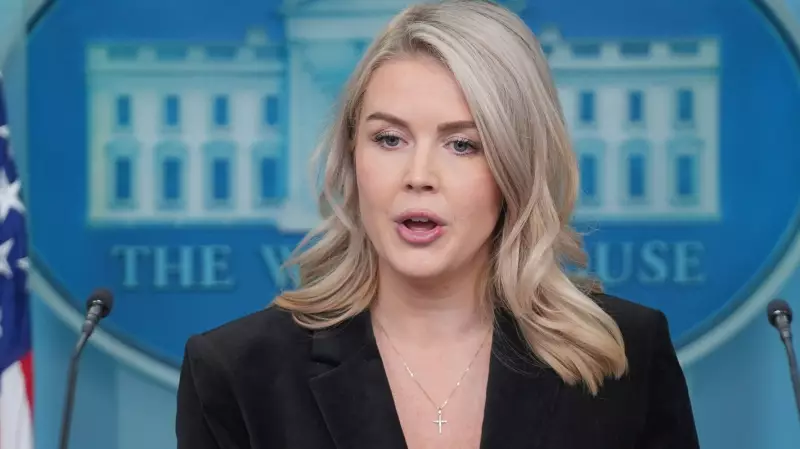
White House press secretary Karoline Leavitt offered a surprising defense of President Donald Trump's behavior during Thursday's press briefing, suggesting journalists should be grateful when he insults them directly.
Defending Presidential 'Frankness'
The exchange occurred when Leavitt was asked about Trump's recent comment to Bloomberg reporter Catherine Lucey, whom he told to be 'quiet, piggy' while aboard Air Force One. The incident happened on Friday, November 14, but only became public this week.
Leavitt responded by framing the president's behavior as a virtue. 'I think the president being frank and open and honest to your faces rather than hiding behind your backs is, frankly, a lot more respectful than what you saw in the last administration,' she told journalists.

She emphasized Trump's straightforward nature multiple times within a single minute, calling him a 'very frank and honest' man and claiming this quality contributed to his reelection.
The Incident and White House Response
The controversial remark occurred when Lucey questioned Trump about potentially incriminating files connected to Jeffrey Epstein that might be held by the Justice Department. Video footage shows Trump wagging his finger at Lucey as she stands off-screen.
Prior to Leavitt's remarks, the White House issued a statement criticizing Lucey's conduct. 'This reporter behaved in an inappropriate and unprofessional way toward her colleagues on the plane,' the statement read, adding 'If you're going to give it, you have to be able to take.'
Leavitt further suggested that reporters bear responsibility for provoking the president's reactions. 'He gets frustrated with reporters when you lie about him, when you spread fake news about him and his administration,' she stated, noting that 'He calls out fake news when he sees it.'
Broader Implications for Media Relations
This incident represents another chapter in the ongoing tension between the Trump administration and news organizations. The defense of personal insults as a form of transparency marks a significant development in White House press relations.
The justification of such remarks as 'frankness' raises questions about the boundaries of presidential conduct and the evolving nature of political communication in contemporary politics.