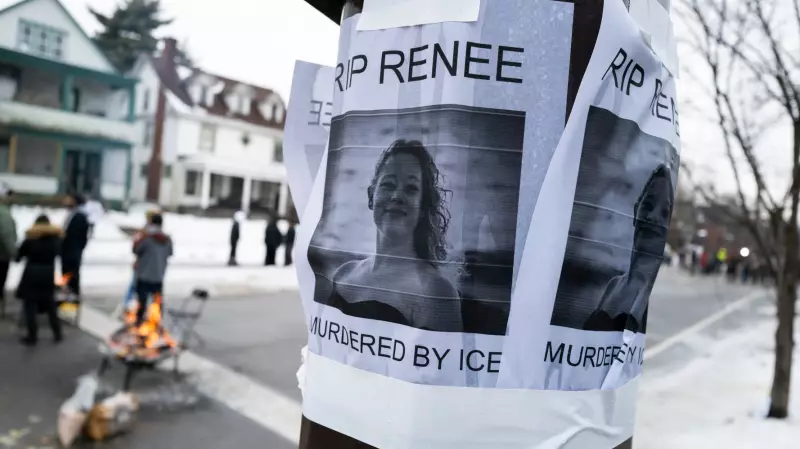
An officer with U.S. Immigration and Customs Enforcement (ICE) shot and killed an unarmed 37-year-old woman in Minneapolis on Wednesday morning, marking the ninth shooting involving the agency since last September. The victim, identified as Renee Nicole Good, was a U.S. citizen reportedly acting as a legal observer during federal operations.
Contradictions Emerge Between Official Narrative and Video Evidence
In the immediate aftermath, a starkly different narrative emerged from Trump administration officials compared to what was captured on video. Homeland Security Secretary Kristi Noem labelled Good a "domestic terrorist," claiming she attempted to run over ICE agents with her vehicle—an assertion later repeated by former President Donald Trump. They argued the agent used force to protect himself and others.
However, circulating video footage and eyewitness accounts tell a different story. The footage shows Good's car was perpendicular to a line of ICE vehicles. Agents can be heard shouting profane orders for her to exit the vehicle while others approached, pulled on her door handle, and reached into her open window. Eyewitness Emily Heller stated Good appeared "obviously scared" and was seemingly trying to leave the scene, contradicting the self-defense claim by suggesting the agent "put himself in front of her."

The video then shows Good reversing and turning her wheels away from the agents. At that moment, one agent fired a shot from the left side of the vehicle, followed by two more as it pulled away.
Political Fallout and a Chilling Justification
The shooting has ignited a fierce debate, with some prominent MAGA-aligned figures arguing the killing was justified. Their reasoning hinges on the victim's failure to instantly obey commands. Representative Wesley Hunt (R-Texas) stated on Newsmax, "When a federal officer gives you instructions, you abide by them, and you get to keep your life."
This argument, echoing justifications in past shootings of unarmed individuals, suggests that a civilian's imperfect compliance under extreme duress warrants a death sentence. It also implies law enforcement cannot be held to a higher standard of judgment or threat assessment, despite their training and role as public servants.
Damon Hewitt of the Lawyers’ Committee for Civil Rights Under Law connected the incident to a broader pattern, noting it occurred less than a mile from George Floyd Square and contributes to a rise in law enforcement killings since 2020. He criticized the administration for escalating tensions with a "surge of militarized law enforcement."
How DHS Policy and the Law Apply to the Shooting
The official justification clashes with publicly available DHS policy and legal precedent. According to DHS guidelines, deadly force is only permitted when an officer has a reasonable belief of an imminent threat of death or serious bodily injury to themselves or another person. It cannot be used solely to prevent escape unless that same threat exists.
Most critically, the policy explicitly states: "DHS LEOs are prohibited from discharging firearms at the operator of a moving vehicle... unless the use of deadly force against the operator is justified." Officers must also consider the hazards of an out-of-control vehicle.
These standards are rooted in Supreme Court rulings like Graham v. Connor, which dictate that force must be "reasonable" based on the circumstances perceived by the officer at the time. The U.S. Department of Justice states officers must prove no reasonably effective, safe, and feasible alternative existed.
The decision to bar state law enforcement from investigating further clouds the path to accountability. Naureen Shah of the ACLU called the shooting the "devastating and predictable" consequence of deploying "reckless, heavily armed agents" into communities with impunity, urging Congress to rein in ICE's budget and authority.
This incident amplifies longstanding concerns about ICE overreach, from aggressive street arrests to the deployment of inexperienced agents. It forces a fundamental question about the limits of state power and the protections meant to shield citizens from extrajudicial violence, a question that resonates deeply for Canadians observing cross-border enforcement trends.