Closing Arguments Presented in High-Stakes Trial Over Deadly Police Pursuit
The central question of who was behind the wheel of a U-Haul truck during a fatal police chase in south Edmonton dominated closing arguments in a Wetaskiwin courtroom this week. The trial of Peter Richard Ashby, who faces multiple charges including dangerous driving causing death, is entering its final stages after several weeks of testimony.
Fatal Collision During Police Intervention
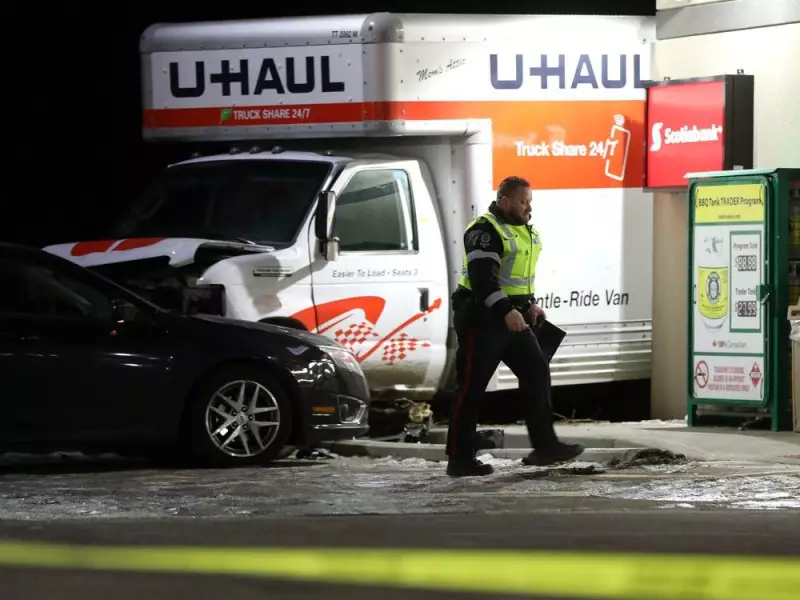
The charges stem from a February 24, 2024, incident where police deployed a spike belt to disable a U-Haul truck allegedly driven by Ashby. During the chaotic pursuit, the damaged vehicle collided with Kassandra Gartner, an uninvolved motorist whose tires had also been affected by the spike belt. Gartner tragically lost her life in the crash, while another bystander sustained injuries.
The pursuit ended near a south Edmonton convenience store, but the legal proceedings have continued for months in the Wetaskiwin courthouse, where Justice Maureen McGuire is presiding over the case without a jury.

Prosecution Points to Notebook as Key Evidence
Crown prosecutor Calvin Patterson presented what he described as compelling evidence linking Ashby to the U-Haul's driver's seat. Among the most significant exhibits was a notebook discovered by police in a Wainwright residence where Ashby was apprehended.
The notebook contained a love letter signed by Ashby, along with what appeared to be analytical notes about the case against him. Patterson read aloud from the notebook in court: "No clothes to match, I need to shave. No witness statements I think. Either way, cops' fault. Criminal negligence causing death. Onus of fault for happening = RCMP. Onus of fault for death = driver."
"This is strong evidence of who the driver of the U-Haul was," Patterson asserted, arguing that the notebook's contents and location provided clear indication of Ashby's involvement and mindset following the incident.
Defense Challenges Strength of Circumstantial Case
Defense lawyer Caitlin Dick countered that the prosecution had failed to meet the burden of proof required for conviction. She characterized the Crown's case as "a chain of circumstantial evidence" with individually weak links.
"The links of the chain include frail eyewitness identification, compromised recognition evidence, poor-quality video evidence, gaps in continuity and unreliable DNA evidence," Dick told the court. She emphasized that two other individuals were present in the U-Haul during the chase, creating reasonable doubt about who was actually operating the vehicle.
Surveillance Footage and Additional Allegations
The prosecution presented security camera and police helicopter footage showing a suspect fleeing the crashed U-Haul. The recordings depict a man wearing shorts and a dark sweatshirt running across a parking lot on 50 Street SW before allegedly stealing a Honda Civic.
Patterson argued this same individual was Ashby, and that he subsequently abandoned a child who had been in the stolen vehicle at a nearby liquor store minutes after the car theft. The Crown maintains that Ashby was responsible for both the U-Haul pursuit and the subsequent vehicle theft.
As Justice McGuire considers the evidence presented during the lengthy trial, the question of driver identity remains unresolved. The case has drawn attention not only for its tragic outcome but for the complex evidentiary challenges involved in determining responsibility during high-speed police pursuits.
The court's decision will ultimately hinge on whether the prosecution has successfully connected Ashby to the driver's seat beyond a reasonable doubt, or whether the defense's arguments about evidentiary weaknesses will prevail.