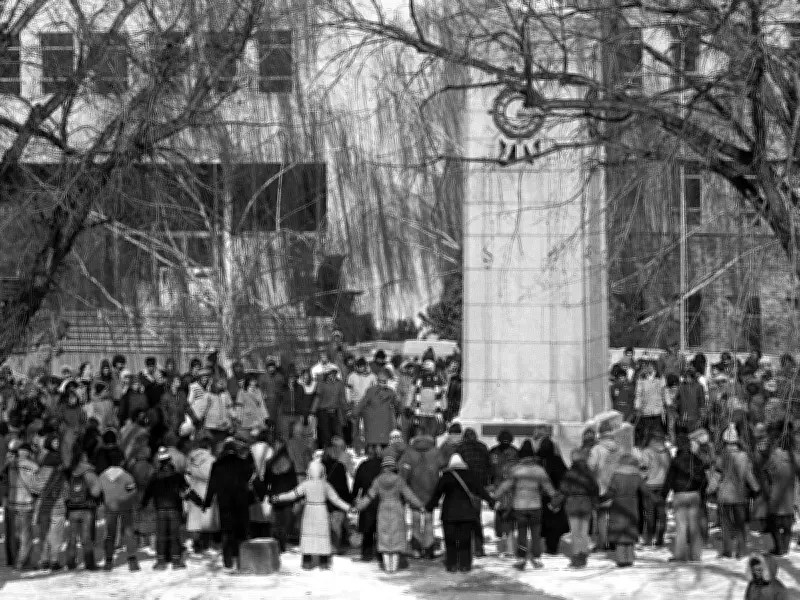
Saskatoon Peace Activists Brave Frigid 1984 Cold to Protest Cruise Missile Tests
On a bitterly cold Saturday in March 1984, approximately 250 determined protesters gathered in front of Saskatoon City Hall, defying harsh winter winds to voice their opposition to recent cruise missile tests. The demonstrators, many wearing solemn black arm bands, assembled at the cenotaph to stage a powerful symbolic protest against Canada's involvement in the escalating nuclear arms race.
A Chilling Demonstration Against Military Testing
The protest, organized by the group Saskatoon Against the Cruise, was originally planned to last thirty minutes but was shortened to just ten minutes due to the extreme cold conditions that gripped the city that day. Despite the abbreviated timeline, participants linked hands around the cenotaph in a powerful display of unity and resistance against what they perceived as government indifference to nuclear proliferation dangers.
Daniel Kuhlen, spokesperson for Saskatoon Against the Cruise, addressed the crowd with poignant remarks about the moral implications of the missile tests. "By military standards the test was a success," Kuhlen stated. "By human standards, however, it only served as an example of Canada's part in the nuclear arms race."

Government Criticism and Peace Movement Growth
Kuhlen expressed frustration with government responses to peace activists' concerns, noting that despite repeated telegrams and protests, officials seemed determined to ignore their demands. "We are often accused of exploiting the press and being melodramatic," he told the assembled protesters, "but despite our efforts the government chooses to close its ears and turn its back on our demands."
The activist invoked the words of Martin Luther King Jr., reminding attendees that humanity faces a critical choice between "non-violent co-existence or violent annihilation." Kuhlen emphasized that the peace movement must serve as "the conscience of humanity when our governments fail to do so."
Looking Toward Political Action
Following the brief demonstration, Kuhlen informed the crowd that their period of mourning had concluded, and the time had come for proactive political engagement. With 1985 designated as an election year, peace activists saw an opportunity to influence government policy regarding further missile testing.
"Five years ago you had to look hard to find a peace group," Kuhlen observed. "Today every community of any size has one. I think the peace constituency in Canada is growing to such an extent that we are being heard."
The spokesperson revealed that Saskatoon Against the Cruise had joined forces with other peace organizations to form an educational caravan aimed at informing Canadians about cruise missile issues. "The purpose of the caravan campaign is to reach as many people as possible," Kuhlen explained, "so when politicians begin campaigning they will have to know exactly where they stand on the nuclear issue. If the politicians don't want to make peace an election issue, we will."
Broader Military Concerns
Kuhlen warned the crowd about broader military pressures facing Canada, noting that the United States was reportedly urging Canadian officials to test not only cruise missiles but an entire new generation of military hardware. This revelation added urgency to the protesters' message about the need for public awareness and political accountability regarding defense policies.
The 1984 Saskatoon protest remains a significant historical moment in Canada's peace movement, demonstrating how local activists braved extreme weather conditions to challenge national defense policies and advocate for nuclear disarmament during a tense period of Cold War politics.