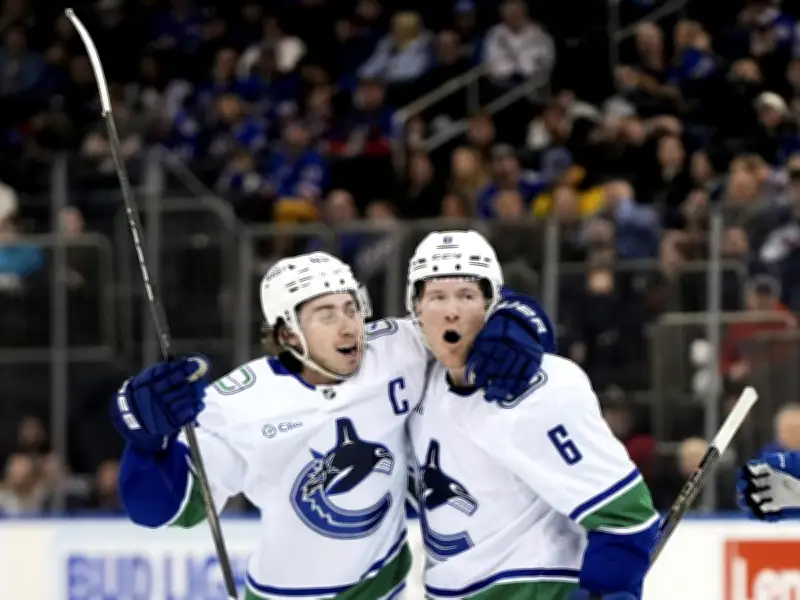
The Vancouver Canucks are set to host a draft party at Rogers Arena on Friday, a decade after a similar event that ended in stunned silence when the team selected Olli Juolevi fifth overall in 2016, passing on power forward Matthew Tkachuk. That decision remains a glaring blemish on the franchise's draft history, which features both spectacular successes and notable failures.
The Juolevi-Tkachuk Fiasco
In 2016, the Canucks had the fifth overall pick and the crowd expected them to select Matthew Tkachuk, a budding power forward who has since become a two-time Stanley Cup champion. Instead, general manager Jim Benning chose defenceman Olli Juolevi, who had nine assists in seven games while helping Finland win gold at the world junior championship. Juolevi managed just three points in 23 games with the Canucks before being traded, while Tkachuk has recorded 670 points (253 goals, 417 assists) in 673 regular-season games, 84 points in 94 playoff outings, and two Stanley Cup rings.
Draft Efficiency Woes
The Canucks' drafting struggles extend beyond that single pick. According to team data, from 2006 to 2015, the Canucks had 62 draft picks and produced only 11 NHL players, a success rate of 17.74%. That is well below the NHL historical average of 28.19% (19 NHL players from 70 picks). The Los Angeles Kings, by comparison, boasted a 37.17% success rate over the same period, with 29 NHL players from 78 picks.

From 2016 to 2020, the Canucks fared even worse: only four NHL players from 34 picks, an 11.76% success rate. The NHL average over those five years remained 28.19%, while the Kings achieved 27.77%.
Best First-Round Picks Since 2000
Despite the misses, the Canucks have made several outstanding first-round selections. Quinn Hughes, taken seventh overall in 2018, is described as a generational talent who changed the game. He became a Norris Trophy winner in 2023-24, posting career highs of 17 goals, 75 assists, and 92 points, setting a single-season record for Canucks defencemen. Elias Pettersson, selected fifth overall in 2017, won the Calder Trophy and became the first member of the 2017 draft class to reach 300 points, doing so in 306 games. He joined elite franchise company with 100-point campaigns alongside Pavel Bure, Henrik and Daniel Sedin, Markus Naslund, and Alex Mogilny. Ryan Kesler, chosen 23rd overall in 2003, was a dominant two-way centre who scored 41 goals in 2010-11 and won the Selke Trophy with 98.3% of the vote. Cory Schneider, taken 26th overall in 2004, paired with Roberto Luongo to win the Jennings Trophy in 2011 and set franchise marks with a 2.2 goals-against average and .927 save percentage over 98 games.
Worst First-Round Picks Since 2000
On the flip side, the Canucks have endured several high-profile busts. Patrick White, selected 25th overall in 2007, never played an NHL game after scoring just 27 goals in four NCAA seasons at Minnesota. He was traded in 2009 to San Jose as part of a deal for Christian Ehrhoff. Olli Juolevi, the fifth overall pick in 2016, appeared in only 23 NHL games, recording two goals and three points, and was dealt to Florida for Juho Lammikko and Noah Juulsen. Nathan Smith, chosen 23rd overall in 2000 after a 28-goal, 90-point WHL season, managed just four games with the Canucks and 26 total NHL games without a point. Jordan Schroeder, selected 22nd overall in 2009, had only six goals in 56 games over two seasons before bouncing around the NHL and Europe.
The Draft Standard
As the article notes, every NHL team has draft skeletons, and the goal for any selection is to get 200 NHL games. The Canucks have hit on stars like Cam Neely, Trevor Linden, Mattias Ohlund, Daniel and Henrik Sedin, Bo Horvat, Brock Boeser, and the current core of Hughes and Pettersson. But the sobering statistics underscore a persistent gap in drafting and development compared to league averages, leaving fans to wonder if the upcoming draft party will bring joy or déjà vu.