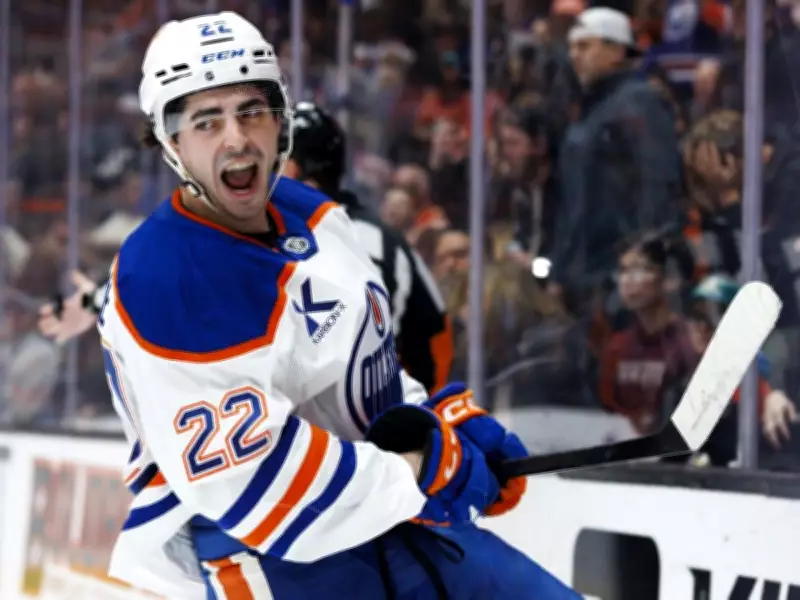
Matthew Savoie: Edmonton's Top-Line Unicorn Succeeding Where Others Have Failed
It's still early in his tenure on Edmonton's top line alongside Connor McDavid, but forward Matthew Savoie has already established himself as a unicorn—a rare success story where numerous other Oilers have struggled to find lasting chemistry with the superstar center.
A Rare Combination of Skill and Physicality
Savoie represents a unique phenomenon not only because few players have demonstrated real staying power when trading pucks with the exceptionally fast and skilled McDavid, but also because he's a smaller, skilled player who simultaneously delivers a hard, physical game. He executes rapid forechecks, wins puck battles in man-to-man confrontations, makes difficult jam and tip shots directly in front of the net, and fights through traffic to create space in the slot for his teammates.
Quantifying the Hard Plays
This season, Savoie has recorded 45 hard plays that have directly contributed to creating Grade A scoring chances at even strength. While Zach Hyman leads the Oilers with 134 such hard plays on Grade A shots, followed by Vasily Podkolzin at 85, Savoie ranks third among Edmonton forwards with his 45 contributions. More impressively, he maintains the third-highest rate per 15 minutes of even-strength play at 0.75 hard plays per 15 minutes.

Most other players operating in this statistical range tend to be larger third or fourth-line grinders—players like Trent Frederic (0.74 per 15), Josh Samanski (0.72), and Mattias Janmark and Curtis Lazar (both at 0.71). For these physical players, grinding out Grade A shots represents their primary offensive methodology for creating scoring opportunities.
Blending Skill with Grit
Similar to Hyman and Podkolzin, Savoie has discovered how to generate Grade A scoring chances through a combination of technical skill and determined grit. The Cult of Hockey has been tracking hard plays at the net on Grade A shots intermittently since the 2010-11 season, revealing that most smaller, skilled attackers don't typically register high numbers in this category.
For comparison, Dominik Kahun recorded less than half of Savoie's rate at just 0.33 hard plays per 15 minutes—a range where Connor McDavid and Leon Draisaitl consistently find themselves year after year. Due to their extraordinary passing and shooting abilities, employing brute force to create Grade A shots isn't the primary role for McDavid and Draisaitl; instead, they dominate possession and accomplish their offensive objectives through puck control.
Historical Context and Player Comparisons
In previous seasons, other highly skilled Oilers players like Ales Hemsky and Jordan Eberle also maintained low rates of hard plays on Grade A shots. Their technical proficiency allowed them to carve out lengthy NHL careers in top-six forward positions without relying heavily on physical, force-based tactics.
This season, finesse forwards Jack Roslovic registers at 0.38 hard plays per 15 minutes, while Ike Howard records just 0.22. Roslovic has scored sufficiently to maintain his lineup position, whereas Howard didn't produce enough offense playing primarily a skill-based game. Howard may need to develop a grittier approach in Bakersfield, learning how to create more Grade A shots through physical play to potentially make his mark in Edmonton in future seasons.
The Yamamoto Parallel and Future Challenges
Oilers fans may recall when Kailer Yamamoto initially joined the team, appearing destined for long-term success as a top-six forward. Like Savoie, Yamamoto was a smaller player possessing high skill levels and an exceptional battle mentality. He combined effectively on a line with Ryan Nugent-Hopkins and Leon Draisaitl during Draisaitl's Hart Trophy-winning 2019-20 season.
That remarkable season saw Yamamoto lead the entire team in hard plays on Grade A shots with 0.89 per 15 minutes—surpassing even the physical Zach Kassian at 0.76—while accumulating 26 points in just 27 games. He appeared to be a home-run draft selection for the Oilers organization.

Savoie now faces two primary challenges: continuing to create scoring opportunities alongside McDavid, and maintaining his health while competing against significantly larger opponents throughout the rigorous NHL season. His unique blend of attributes has positioned him as Edmonton's latest top-line unicorn—a rare find who might finally provide the consistent, complementary presence that has eluded so many others alongside hockey's most dynamic player.