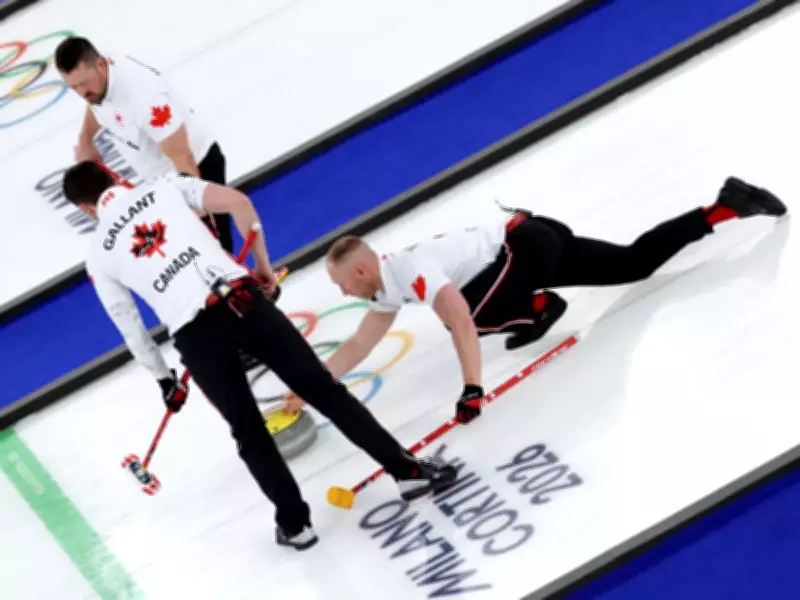
From Controversy to Gold: Team Brad Jacobs Claims Olympic Curling Victory
In what became one of the most dramatic storylines of the Winter Olympics, Canada's Team Brad Jacobs transformed from perceived villains to celebrated champions, capturing Olympic gold in men's curling after navigating through significant controversy during the tournament.
The Golden Moment in Cortina
Brad Jacobs and his Canadian teammates secured Olympic glory with a hard-fought 9-6 victory over Great Britain's Bruce Mouat at the Cortina Curling Olympic Stadium. The gold-medal match evolved into a strategic battle that culminated in a decisive ninth end, where Jacobs executed a crucial three-point score to establish an 8-6 advantage over the British team.
Following their victory, the Canadian squad celebrated with an emotional group embrace before rushing to engage with their supporters in the Canada cheering section. Meanwhile, Mouat and his British teammates shared heartfelt moments of consolation as they processed their silver-medal finish.

A Match of Strategic Complexity
The championship game unfolded with intense back-and-forth action between the two curling powerhouses. Canada began with the hammer but managed only a single point in the opening end. Great Britain responded with a double score in the second end, only to have Jacobs answer with two points of his own in the third.
The strategic complexity escalated through the middle ends, with both teams executing precision takeouts and defensive maneuvers. Kennedy and Jacobs connected on three consecutive double takeouts in the fifth end, though they couldn't completely clear the house to maintain their advantage. Mouat delivered what commentators described as a "monster shot" in the sixth end, executing another double takeout to reclaim the lead.
The tension peaked in the seventh end when Canada's attempt to blank the end and retain hammer advantage for the tenth began to unravel. Jacobs managed to create scoring pressure against Mouat, but the British skip responded with another precise takeout around his own guard to limit Canada to a single point.
Navigating the Double-Touch Controversy
The path to gold was complicated by what became known as "the mother of all curling controversies" during the tournament. Third Marc Kennedy found himself at the center of international attention when Swedish curler Oskar Eriksson accused him of making contact with his stone after release.
The incident gained momentum when Swedish television broadcast footage appearing to show Kennedy's finger grazing the back of a rock during delivery. While many experienced curlers noted that such incidental contact typically has minimal effect on a forty-pound stone's trajectory, the images circulated globally, prompting widespread debate about potential interference.
Kennedy apologized for his heated language directed at Eriksson but maintained that any contact was unintentional. The situation escalated further when Canadian team members questioned the propriety of Swedish television's hogline recording setup, though Swedish broadcaster SVT defended their filming practices.
Overcoming Adversity to Claim Victory
Despite the swirling controversy and intense media scrutiny, Team Jacobs maintained their competitive focus throughout the Olympic tournament. Kennedy acknowledged the significant attention surrounding the double-touch incident but emphasized that from within the Olympic environment, the team remained concentrated on their performance objectives.
The gold-medal victory represents a remarkable comeback narrative for the Canadian squad, who transformed from being labeled by some observers as "the bad boys of curling" to standing atop the Olympic podium as champions. Their journey through controversy to ultimate triumph adds another compelling chapter to Canada's rich curling history on the international stage.
As the Olympic curling competition concludes, Team Brad Jacobs' victory demonstrates the resilience required to overcome both on-ice challenges and off-ice distractions at sport's highest level, securing Canada's position as a continuing force in international curling competition.