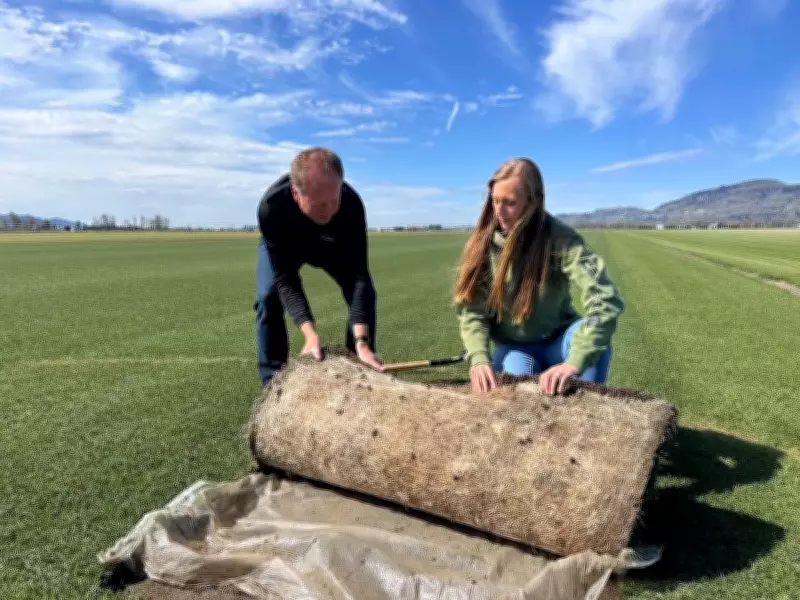
B.C. Place's World Cup Turf Cultivated at Family Farm in Fraser Valley
The task of creating a new grass playing surface for B.C. Place, which will be broadcast to hundreds of millions of viewers worldwide during the World Cup, has been entrusted to a family-operated sod farm located in Abbotsford, nestled at the base of Vedder Mountain in the Fraser Valley lowlands.
Bert Bos, who founded Bos Sod Farm in 1993 after moving from Alberta where his family runs two other farms, oversees this high-profile project. Despite previous large-scale endeavors such as a golf course in Whistler and a practice field for Boise State University in Idaho, this assignment represents their most significant undertaking to date.
Initial Hesitation and Family Influence
Initially, Bert Bos was reluctant to take on the project due to past challenges, particularly drainage issues exacerbated by the 2021 floods that submerged their farm under 1.5 metres of water, rendering buildings uninhabitable for months. However, his children—Nicoline, Jaron, and Caleb, who all work on the farm—encouraged him to reconsider, emphasizing the feasibility and potential of the hybrid turf system specified by FIFA.

"I was a little lax," Bos admitted with a laugh, reflecting on his early doubts. The family's persistence led to a deeper evaluation, revealing that the hybrid product allowed for customization to suit local climate conditions and facility requirements.
Innovative Hybrid Turf Design
The hybrid system incorporates a mesh grid with artificial grass fibers comprising about five percent of the surface, stitched together using an oversized sewing machine. This grid is laid over a laser-graded layer of sand and peat, seeded with a precise mix of 84 percent Kentucky Bluegrass and 16 percent perennial ryegrass. Bos had the autonomy to determine these ratios and selected Butler Concrete and Aggregate in Duncan as the sand supplier, supporting local business and avoiding potential tariffs.
This design ensures that as the grass roots grow through the artificial grid and reach a perforated plastic underlay, they spread horizontally, forming a tight and robust root system resistant to cleat divots and tearing. The fields were planted in June and have recently achieved a height of 22 millimetres, matching the artificial fibers, with plans to trim them before installation at B.C. Place.
Lessons from Past Experiments
FIFA's experience with the Club World Cup in the U.S. last year informed key decisions, such as replacing Bermuda grass with Kentucky Bluegrass after player complaints likened the surface to a putting green rather than a soccer pitch. These insights have been integrated into the current project to enhance performance and player satisfaction.
"I'm very glad they went with the carpet system for Vancouver; I think it's really bulletproof. It's going to be pretty tough to beat this," Bos stated. He emphasized the high stakes involved, noting that sod production requires long-term planning, making last-minute corrections difficult. "With this kind of exposure, the stakes are pretty high. So there's quite a lot of pressure to make sure you get everything on, everything correct... It's huge pressure."
The resilient, divot-resistant base aims to provide a consistent and predictable playing surface, crucial for the global spotlight of the World Cup, showcasing British Columbia's commitment to quality and innovation in sports infrastructure.