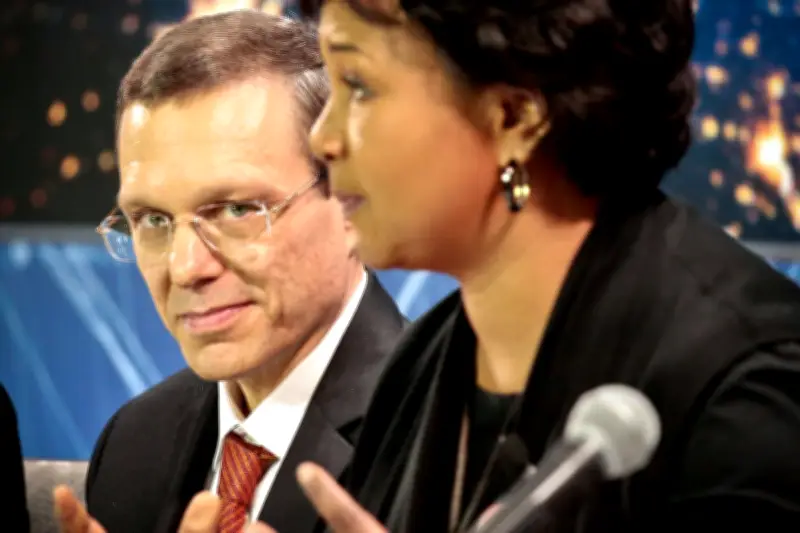
Harvard physicist Avi Loeb, a professor known for his controversial theories about extraterrestrial life, has been picked to lead a new White House UFO council, the administration announced. Loeb, who has advocated for serious scientific investigation of unidentified aerial phenomena (UAP), will head the panel tasked with coordinating government efforts to study and address UFO sightings.
Loeb's Background and Controversies
Loeb, the Frank B. Baird Jr. Professor of Science at Harvard University, has long argued that some UFOs could be evidence of alien technology. He gained attention for his hypothesis that the interstellar object 'Oumuamua, detected in 2017, might be an alien spacecraft. Many scientists have criticized his views as lacking evidence, but Loeb insists on the need for open-minded inquiry.
In 2021, he launched the Galileo Project, an initiative to systematically search for extraterrestrial artifacts near Earth. The project uses telescopes and other instruments to detect UAP. Loeb has also called for the U.S. government to release more data on UFO sightings, which he says could reveal groundbreaking discoveries.

New White House Council's Mission
The White House UFO council, formally named the Unidentified Aerial Phenomena Task Force (UAPTF), will include representatives from the Pentagon, intelligence agencies, and scientific institutions. Its mission is to standardize reporting, analyze data, and assess potential national security threats from UAP. The council will also work to reduce stigma around reporting sightings, which officials say has hindered investigations.
According to a White House statement, Loeb's appointment reflects a commitment to rigorous scientific analysis. “Dr. Loeb brings a unique perspective that combines academic rigor with a willingness to explore unconventional hypotheses,” the statement said. The council is expected to release its first public report within a year.
Reactions and Implications
The selection has drawn mixed reactions. Supporters praise Loeb for pushing mainstream science to take UFOs seriously. Critics argue his polarizing reputation could undermine the council's credibility. “Loeb is a brilliant scientist, but his alien claims are speculative,” said Dr. Sarah Johnson, an astrophysicist at MIT. “However, his leadership might encourage more transparency.”
The council's formation comes amid growing government interest in UAP. In 2022, the Pentagon established the All-domain Anomaly Resolution Office (AARO) to investigate sightings. The new council will coordinate with AARO and other agencies. Loeb emphasized that the goal is not to prove aliens exist but to apply scientific methods to unexplained phenomena.
Next Steps
Loeb is expected to convene the council's first meeting within weeks. The panel will prioritize analyzing declassified military data and developing protocols for civilian reporting. Loeb stated, “We must approach this with humility and curiosity. The truth is out there, and it's our job to find it.”