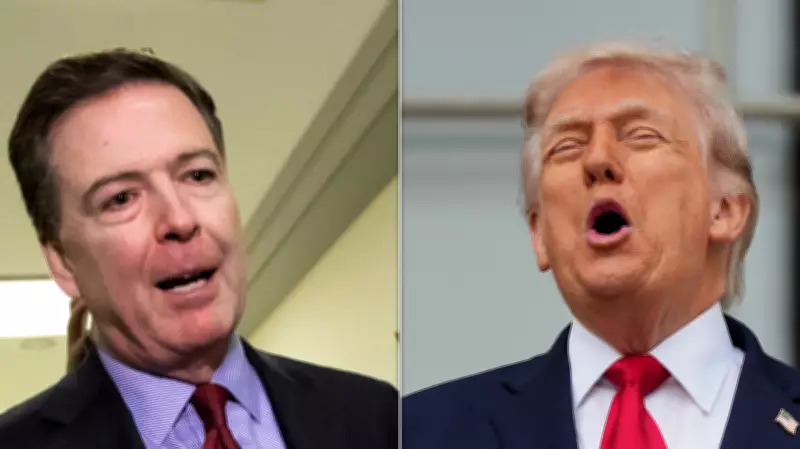
CNN senior legal analyst Elie Honig believes President Donald Trump might have just tanked his Department of Justice's criminal case against former FBI Director James Comey after the president vacillated on Wednesday about whether Comey had really threatened his life in a seashell message.
The Seashell Incident
Comey was indicted earlier this week after sharing a now-deleted image on social media of seashells arranged on a beach to read "86 47." (Trump is the 47th U.S. president.) Trump told reporters on Wednesday that the term "86," commonly used in restaurants to signal to staff to discard a food item, was a "mob term for 'kill him.'"
"The Source" host Kaitlan Collins followed up by asking the president if he really thought his life was in danger.

"Probably, I don't know," Trump responded. "Based on what I'm seeing out there, yeah. People like Comey have created tremendous danger, I think, for politicians and others."
Legal Implications
"Right there. That's an acquittal," Honig said on Collins' show later on Wednesday. "Because prosecutors have to prove beyond a reasonable doubt that the victim believed that his life was in jeopardy, and if the jury comes back at 'probably, I don't know,' that's a not guilty right there. I thought that was a really important moment."
Comey has maintained his innocence and said he assumed that the numbers in his seashell arrangement reflected a political message, not violence. Honig, who said he had experience prosecuting members of the mob, disputed Trump's mobster terminology argument, saying he'd never heard "any real-world gangster use the term '86' to refer to a murder or anything."
"I don't know where the president is getting this from," Honig continued. "He said from some movie. They don't use that term in 'Godfather' or 'Sopranos' or 'Goodfellas,' maybe some way old-timey movie, but that's not reality."
Future of the Case
Honig told Collins that Trump's "probably, I don't know" comment would be "an interesting tack" if used in the case.
"I don't think it'll ever get to a trial. I think it'll be tossed out before that on other grounds, but I'd be fascinated to see how that played out," Honig said.
This would be the second time Comey faces a federal case from the DOJ, and Honig predicted Comey will argue that the case brought against him now is one of "selective prosecution," because others have made similar comments about the president without facing prosecution.
"I mean, look at Donald Trump's social media posts saying 'I want him indicted,'" Honig added. "Look at the fact that they tried once, and Comey beat him on that case. So to me, it's a textbook case of vindictive prosecution. Maybe selective as well."