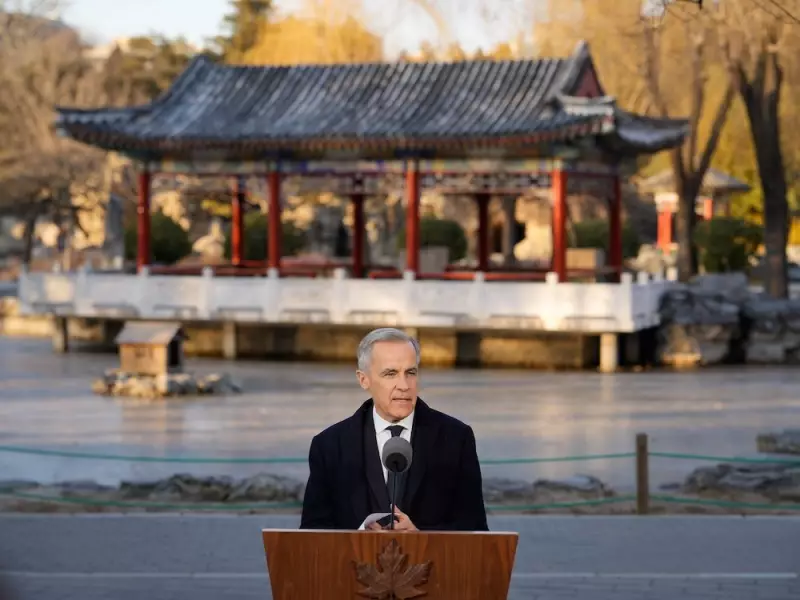
Prime Minister Mark Carney's recent diplomatic mission to Beijing has culminated in a significant trade agreement with China, one that is poised to reshape automotive imports and has ignited a fierce debate over national security and Canada's relationship with the United States.
The Core of the Beijing Agreement
The deal, finalized on Friday, January 16, 2026, centers on electric vehicles (EVs). Under the new terms, 49,000 Chinese-manufactured electric vehicles will be permitted to enter the Canadian market annually. The tariff applied to these imports will plummet to six per cent, a dramatic reduction from the previous rate of 100 per cent.
In return, China has agreed to substantially lower its own trade barriers on key Canadian exports. Tariffs on Canadian canola products and seafood, which previously ranged from 25 to 75 per cent, will be reduced to either zero or 15 per cent. This aspect of the deal offers a potential lifeline to Canadian farmers and fisheries who have faced challenging market access.

Security Concerns and Strategic Ambitions
While the agreement may deliver economic benefits to certain sectors and align with federal net-zero emissions goals, it has immediately raised red flags among security analysts. Critics argue the prime minister has effectively greenlit nearly 50,000 potential vectors for malign software to enter the country each year, pointing to longstanding and genuine concerns about data security and embedded technology in Chinese-made vehicles.
Beyond the immediate import numbers, Carney's statements in Beijing suggested a broader ambition. He indicated the ultimate goal is to "drive considerable Chinese investment into Canada’s auto-sector." This strategic pivot comes at a time when U.S. policy under President Donald Trump is explicitly designed to counter Chinese influence in North America. Trump's administration has previously cited Chinese investment in Mexico as a backdoor to the U.S. market, a scenario that could now be replicated with Canada, potentially jeopardizing the critical Canada-U.S. trading relationship.
A Strained Relationship with the United States
The timing of this deal is particularly delicate. The 100 per cent tariffs on Chinese EVs were originally imposed by Canada to align with measures set by former U.S. President Joe Biden less than two years ago. By unilaterally slashing these rates, the Carney government risks a significant diplomatic and trade confrontation with Washington.
President Trump's "National Security Strategy," released in late 2025, is squarely focused on ejecting Beijing's influence from the Western Hemisphere. Carney's embrace of Chinese automotive investment and his framing of a "new strategic partnership" with China appear to directly challenge this American priority. During the visit, Carney and his ministers offered notably warm praise for the Chinese government, leading some observers to question whether the trip's underlying purpose was to distance Canada from its southern neighbor.
This shift occurs despite recent tensions in the Canada-China relationship, including incidents of alleged election interference and the detention of Canadian citizens. The Prime Minister's characterization of this moment as a "new era" signals a deliberate recalibration of foreign policy, one that bets on China's economic future but carries substantial risk regarding Canada's most important economic and security partnership with the United States.