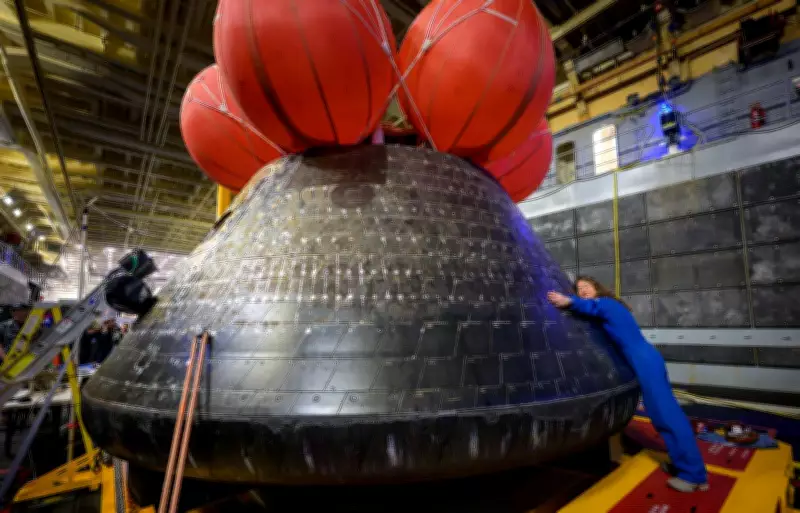
NASA's Artemis II Orion spacecraft has safely returned to its launch site at the Kennedy Space Center in Florida, concluding a historic 10-day mission that took astronauts around the Moon and back. The capsule arrived at the Vehicle Assembly Building on April 28, 2026, after being transported from the USS John P. Murtha, where it was recovered following its splashdown in the Pacific Ocean off the coast of California on April 11.
Mission Highlights
The Artemis II mission, which launched on March 30, 2026, carried a four-person crew—Commander Reid Wiseman, Pilot Victor Glover, Mission Specialist Christina Koch, and Canadian astronaut Jeremy Hansen—on a journey that circled the Moon and returned safely to Earth. This was the first crewed lunar flyby since Apollo 17 in 1972 and a critical test of the Orion spacecraft's systems for future missions.
During the mission, the crew conducted a series of experiments and observations, including testing life support systems and navigation hardware. They also captured stunning images of the lunar surface and Earth, which were shared worldwide.

Return to Launch Site
Upon its return, the Orion spacecraft was carefully offloaded from the recovery ship and transported via a specialized trailer to Kennedy Space Center. Engineers will now conduct a thorough inspection and analysis of the capsule to assess its performance and identify any issues that need to be addressed before Artemis III, which aims to land astronauts on the lunar surface.
NASA Administrator Bill Nelson praised the mission's success, stating, 'Artemis II has proven that Orion is ready for the challenges of deep space exploration. We are one step closer to returning humans to the Moon and eventually reaching Mars.'
The spacecraft's return marks a significant milestone in the Artemis program, which seeks to establish a sustainable human presence on the Moon by the end of the decade.