Tax Resistance Movement Gains Momentum as Americans Protest Trump Administration Policies
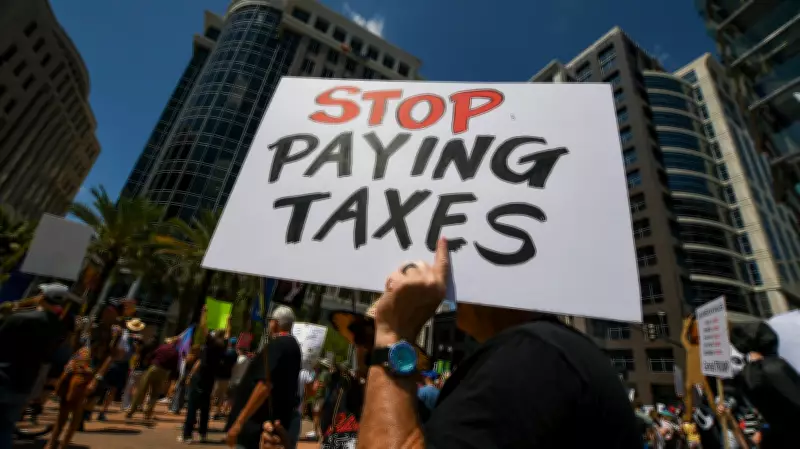
While the federal tax deadline traditionally falls on April 15, a significant and growing number of American citizens are deliberately choosing to withhold their payments this year. This act of financial defiance serves as a powerful form of protest against the policies and actions of President Donald Trump's administration.
Personal Convictions Drive Financial Protest
Attorney and activist Rachel Cohen stands among those taking this bold stance. Cohen, who has previously faced pepper spray and tear gas while protesting Immigration and Customs Enforcement's deportation practices, decided that withholding her federal tax dollars represented another crucial form of resistance. She publicly announced her refusal to pay over $8,800 in federal income taxes through social media and her Substack publication.
"I found myself sitting questioning, how on earth I could hold the truth of 'I think this is worth bodily harm to protest and resist,' and also 'I'm going to turn over thousands of dollars that will go in part to funding this,'" Cohen explained in an interview. While she emphasizes she is not encouraging others to follow her example, Cohen stated that the general lack of awareness about this form of protest motivated her to speak publicly about her decision.

Cohen's commitment to principle is not new. In 2025, she publicly resigned from her prestigious law firm over a deal she claimed they made with the Trump administration. Her current tax refusal represents a continuation of her opposition.
Historical Precedent Meets Modern Surge
The concept of war tax resistance has deep roots in American history, dating back to the Founding Fathers and experiencing periodic revivals during times of military conflict. However, organizers report a notable surge in interest specifically targeting the current administration.
Lincoln Rice, a coordinator at the National War Tax Resistance Coordinating Committee, observed a dramatic increase in engagement. Shortly after President Trump's second inauguration, the organization's website recorded a personal record of 110,000 unique visitors. Attendance at informational sessions has more than doubled this tax season compared to the previous year.
"Last tax season, it was typical for around 100 to 200 to show up to an informational session," Rice noted. "And this tax season, it has been between 200 to 500, which is significantly more."
Rice identified several key events as catalysts for this growing movement. For many, the U.S. support of Israel's military actions in Gaza served as a tipping point. For others, it was specific domestic policies or international interventions. In recent months, the killings of U.S. citizens by federal immigration enforcement in Minneapolis and the U.S.-Israel military actions against Iran have become major drivers of new tax resistance.
Significant Financial and Legal Risks
While the moral impulse behind tax refusal is strong, the practical consequences can be severe. Unlike conscientious objection to military service, refusing to pay federal taxes on principle is not legally protected.
The Internal Revenue Service possesses substantial enforcement powers. Although not common, the agency has garnished wages of war tax resisters, requiring employers to divert a portion of salaries to cover tax debts. The IRS has also levied bank accounts, potentially seizing funds up to the amount of tax owed.
Historical examples illustrate the potential severity. Peace activist Randy Kehler lost his home to IRS seizure in 1989 after years of tax refusal. While jail time for willful failure to pay taxes remains rare, it represents a theoretical risk. The IRS also charges accumulating interest on overdue balances, and once penalties exceed $66,000, individuals cannot renew their passports.
Financial experts caution that the penalties for failing to file tax returns are substantially worse than those for simply failing to pay. Consequently, many tax resisters continue to file their returns even while withholding payment.

"It's an expensive protest," said Minnie Sage, program director of Tax-Aid, a nonprofit providing free tax services. "I don't recommend it. I think you're causing a bigger disruption in your financial life... There are other ways to protest."
Rice noted an important distinction in protester behavior: most war tax resisters continue paying state taxes, as state governments generally do not engage in foreign military actions that protesters find morally objectionable.
Protesters Believe Risks Are Justified
Despite the considerable risks, participants in the tax resistance movement believe their actions are necessary for meaningful societal change.
Kat Olson, a volunteer with National Tax Strike, is withholding her federal tax payment for the first time this year. For Olson, the risk of funding policies under what she describes as "a madman in the White House" outweighs the personal financial consequences. She cited fatal ICE shootings, particularly the death of Silverio Villegas González in Chicago during Operation Midway Blitz, as her personal breaking point.
"That could have been my family," Olson stated emotionally.
Olson has engaged in what protesters call "W-4 resistance," stopping the withholding of federal taxes from her regular paycheck. She acknowledges this will likely result in a substantial tax bill and potential penalties but remains resolute.
"I was nervous throughout the whole year, but now that it's come time to make that decision to not pay my taxes, I feel very resolute," Olson explained. "I can take a sternly worded [IRS] letter. That does not scare me. What scares me is my neighbors being taken out of their homes."
This sentiment captures the fundamental calculation of the growing tax resistance movement: that the moral cost of compliance with certain federal policies exceeds the substantial personal risks of financial protest.