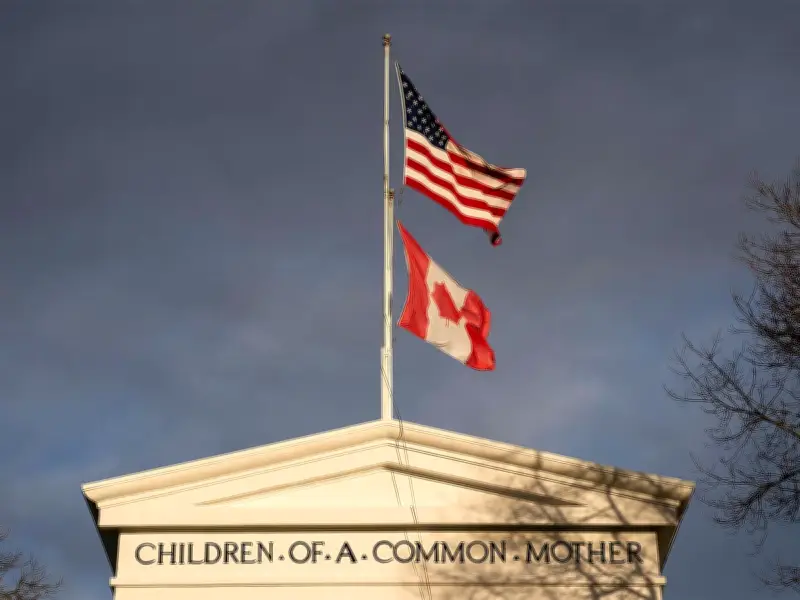
Canadians of goodwill toward the United States approach the semiquincentennial of the Declaration of Independence from a unique perspective. If the Founding Fathers had succeeded in the Revolutionary War and again in 1812, Canada would not exist as it does today. In 1776, the Continental Army under George Washington laid unsuccessful siege to Quebec City.
The Genius of the Declaration
The genius of the Declaration is that even those who opposed its particular political project can admire its account of human rights and aspirations of liberty. The question remains: how should Canadians think about America's 250th birthday?
On America's 142nd birthday in 1918, Winston Churchill gave an address in Central Hall, Westminster, marking a high point in Anglo-American cooperation during the last months of the Great War. Churchill, then minister of munitions, had recovered politically from the Gallipoli failure two years earlier.

Churchill's Vision of Shared Liberty
Churchill spoke of the entire "English-speaking family united in a brotherhood of arms." The achievements of America were an occasion of pride in the imperial capital. As to the Declaration itself, "a great harmony exists between [its] spirit and language and all we are fighting for now."
"A similar harmony exists between the principles of that Declaration and all that the British people have wished to stand for," Churchill continued, stretching history to his rhetorical purposes, and including Canada as well. "And have in fact achieved at last both here at home and in the self-governing Dominions of the Crown."
Magna Carta as the Foundation
The core of Churchill's argument is that "the Declaration is not only an American document. It follows on Magna Carta and the Bill of Rights (1688) as the third great title-deed on which the liberties of the English-speaking people are founded."
Churchill traces the origin of political liberty and limited government to Magna Carta (1215). Four centuries later, in the standard British telling, the king was no longer observing those limits, leading to the Glorious Revolution of 1688, which dethroned him in favor of a new king and a new affirmation of the rights of Parliament.
A Thread of Continuity
Some 90 years later, the Americans, in listing their grievances against the king, echoed the Bill of Rights. Sometimes a revolution is needed—Glorious or American—to keep things the same. Thus Churchill saw the thread of continuity, with Britain adding an empire of ideas to its traditional empire of lands.
"We lost an Empire, but by it we also preserved an Empire," Churchill said. "By applying the Declaration's principles and learning its lesson we have maintained our communion with the powerful Commonwealths our children have established beyond the seas."