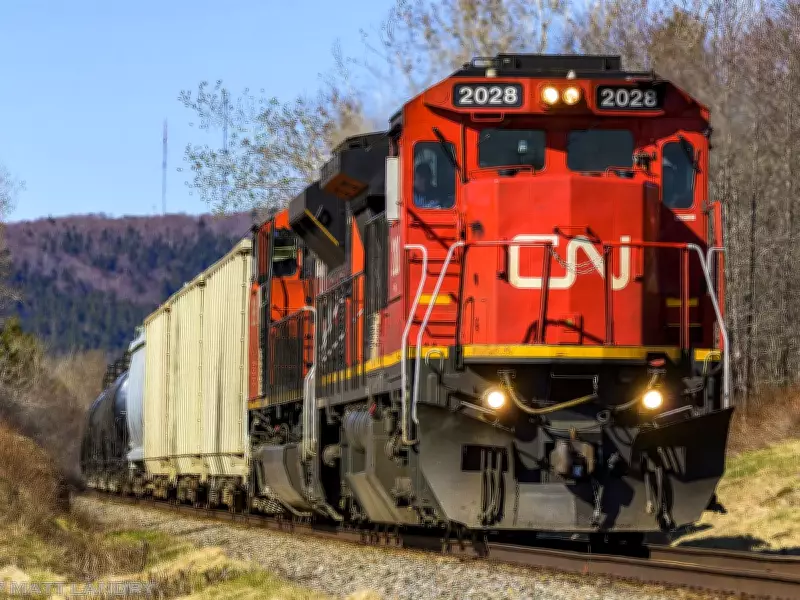
Canada's two largest railways, Canadian Pacific Kansas City Ltd. (CPKC) and Canadian National Railway Co. (CN), are navigating a turbulent period marked by trade uncertainty and rising energy costs. On Wednesday, both companies reported lower revenues for the first quarter, triggering a sell-off in their shares. CN's stock dropped six per cent to approximately $149 per share, while CPKC shares declined nearly three per cent to $115 each.
Fuel Prices Drive Earnings Concerns
Ghislain Houle, executive vice-president and chief financial officer at CN, described fuel costs as a "dark cloud" over the second quarter. The conflict in Iran and disruptions at the Strait of Hormuz have pushed global oil prices upward over the past two months. On Wednesday afternoon, North American oil prices surged to nearly US$110 per barrel, their highest level in weeks. High oil prices have raised fuel costs for rail operators, truckers, airlines, and consumers, and are expected to contribute to inflationary pressures.
Houle noted that if fuel prices remain at current levels, they will further impact CN's earnings per share, a key metric for valuing the company. Fuel costs already reduced CN's earnings per share by four cents in the first quarter, and Houle anticipates an additional two-cent decline over the summer if high prices persist. "Obviously, we don't control fuel prices," Houle said, adding that CN may be less affected by fuel costs in the latter half of 2026.

Despite these challenges, CN's earnings per share rose one per cent to $1.87 compared to the same period last year. In contrast, CPKC's earnings per share fell three per cent to $0.94 year-over-year.
CPKC's Perspective on Fuel Volatility
Keith Creel, chief executive of CPKC, acknowledged that the Calgary-based railway has experienced some impact from fuel prices since volatility emerged. However, he expressed optimism, stating, "That said, that tide has turned." During a Wednesday earnings call, Creel noted he is pleased with the company's performance despite elevated costs. At a March conference, Creel indicated that increased fuel prices had a four-cent impact on earnings, but CPKC plans to recover these costs through surcharges.
Opportunities Amidst Challenges
Tracy Robinson, CN's chief executive, sees potential opportunities arising from the current situation. She highlighted that the heightened public attention on energy underscores the importance of resources worldwide. "That, over the longer term ... presents significant opportunities for us," Robinson said, emphasizing that CN's network is strategically located near various natural resources that the global economy demands. She also noted that CN is engaged in discussions about expanding capacity at major Canadian ports, including the Port of Prince Rupert, Vancouver, Montreal, and Halifax.
Trade Uncertainty Looms
Both CN and CPKC, which have substantial operations on both sides of the Canada-U.S. border, faced a combined $550-million hit from U.S. tariffs last year. While goods covered under the Canada-U.S.-Mexico Agreement (CUSMA) have so far remained tariff-free, the agreement is scheduled for review in July. Prime Minister Mark Carney has tempered expectations for the talks, stating last week that reaching a successful outcome in negotiations with President Donald Trump will "take some time."